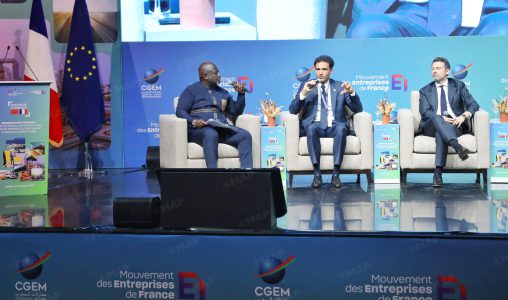
Morocco’s southern provinces have become a genuine catalyst for economic cooperation between Morocco and France, offering new opportunities for shared growth and regional integration across Africa, economic actors from both countries said on Thursday in Dakhla.
Speaking at the Morocco–France Economic Forum, participants unanimously emphasized the central role of Morocco’s southern regions in strengthening the strategic partnership between Rabat and Paris.
They highlighted the scale of ongoing investments, the agricultural and energy potential of the region, and its strategic position as a hub for African integration, all in line with the enlightened vision of His Majesty King Mohammed VI.
In his remarks, the Vice-President of the General Confederation of Moroccan Enterprises (CGEM), Mehdi Tazi, underscored the importance of the forum in showcasing “the considerable assets of Morocco’s southern provinces,” describing the region as one that “abounds in immense potential.”
Tazi recalled that the Dakhla–Oued Eddahab region holds major agricultural promise, with natural conditions that are ideal for the development of renewable energy, thanks to its consistent sunshine and strong wind resources.
For his part, the Vice-President of the Movement of the Enterprises of France (MEDEF), Fabrice Le Saché, said the presence of French business leaders in Dakhla reflects “a clear desire for tangible economic cooperation based on dialogue, understanding, and mutual respect.”
He highlighted the clarity of Morocco’s development model for its southern provinces, describing it as “a project that transcends national borders and serves as a gateway to sub-Saharan Africa.”
The Co-President of the Morocco–France Business Leaders Club, Mohamed El Kettani, underlined the symbolic importance of holding the forum in Dakhla, noting that it demonstrates “France’s recognition of Morocco’s sovereignty over its southern provinces.”
El Kettani also cited examples of existing French investment in the region, including the seawater desalination project jointly developed by Morocco’s Nareva and France’s ENGIE.
For his part, the Club’s Co-President, Ross McInnes, stressed the integrated industrial dimension of the Franco–Moroccan partnership, which he said is “built on a comprehensive approach to the value chain, from design and investment to procurement, manufacturing, and export.”
McInnes praised the high quality of Moroccan engineering education, which he said enables the country to “develop advanced technological projects in sectors such as automotive, aerospace, and energy.”
He noted that these industries “rely heavily on the skill, creativity, and reliability of local subcontractors,” which has positioned Morocco as a trusted partner in global supply chains.
The forum, organized by CGEM and MEDEF through the Morocco–France Business Leaders Club, highlighted the shared ambition of both countries to deepen economic ties and promote investment in strategic sectors.
It also reaffirmed Morocco’s growing role as a regional gateway and a bridge for cooperation between Europe and Africa, anchored in sustainable development and mutual prosperity.