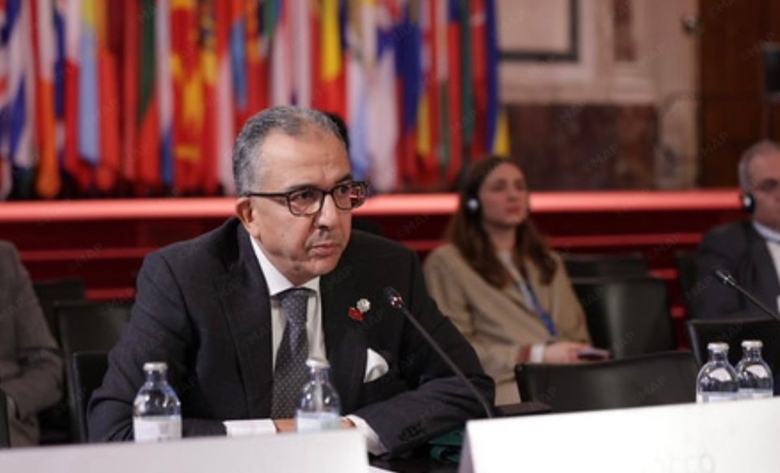
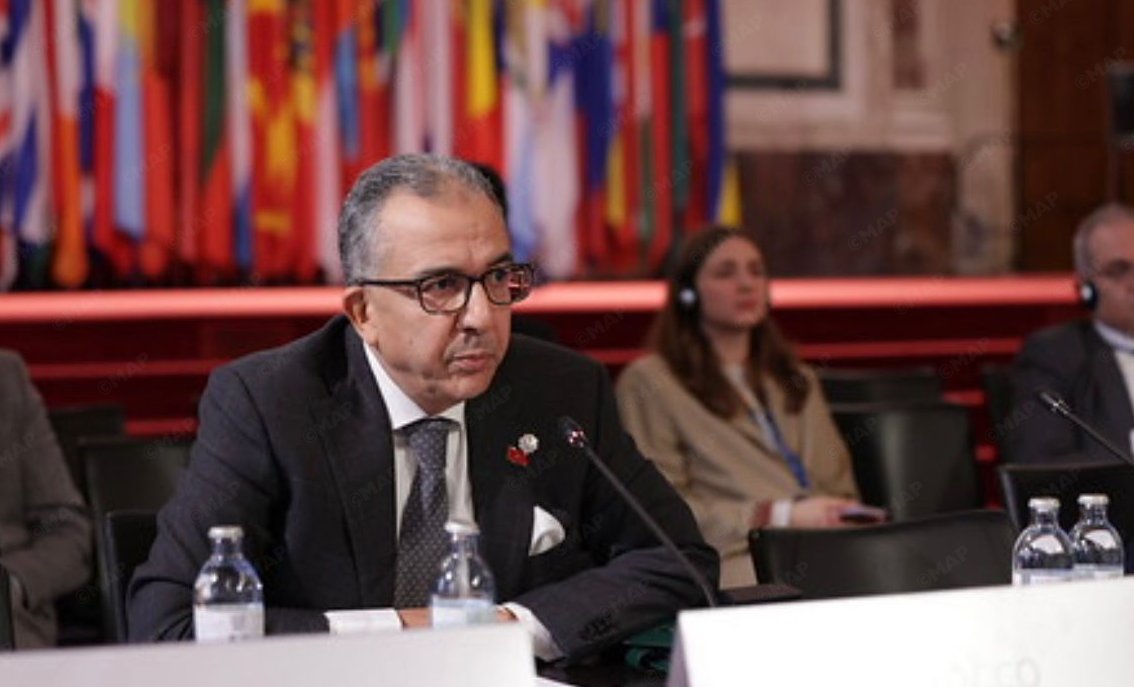
Morocco’s Permanent Representative to the United Nations Office and international organizations in Vienna, Ambassador Azzeddine Farhane, said that UN Security Council Resolution 2797, adopted on October 31, 2025, has firmly established the Moroccan autonomy initiative as the sole framework for negotiations to resolve the regional dispute over Western Sahara.
Speaking during the 32nd Ministerial Council of the Organization for Security and Co-operation in Europe (OSCE) held in Vienna, Farhane stressed that the resolution reaffirmed the political and legal foundations governing the UN-led settlement process, emphasizing that Morocco’s sovereignty and territorial integrity have become an unavoidable framework for any future negotiations.
He added that the Security Council resolution explicitly called on the concerned parties, particularly Algeria, to engage seriously in the UN-sponsored political process to reach a definitive solution, noting that the current momentum represents an opportunity that should be seized to end a long-running dispute.
Turning to Morocco’s vision within the OSCE space, Farhane said Rabat’s commitment to the principles of the Helsinki Final Act is reflected in its active support for the Mediterranean Partnership. He underlined that the growing challenges in the Mediterranean region require greater focus on the geostrategic dimension and its associated security and development stakes.
The ambassador highlighted that Morocco has, over the past years, built relations based on trust, dialogue and cooperation with its Euro-Mediterranean partners, describing this approach as fundamental in dealing with complex regional crises. He stressed that Morocco views its partnership with the OSCE as a framework capable of evolving into a genuine strategic alliance, enabling the development of more effective initiatives.
Farhane also underlined the central role of involving regional actors in any conflict-resolution process, arguing that the complexities of the Mediterranean reality require broader approaches based on negotiation, realism and consensus. He warned that threats linked to separatism, terrorism, transnational organized crime and climate change make such an approach a necessity rather than a choice.
Addressing tensions within the OSCE area, the Moroccan diplomat referred to the situation in the Middle East, noting that Morocco continues to support peace initiatives. He recalled the message sent by King Mohammed VI on November 26 to the Chair of the UN Committee on the Exercise of the Inalienable Rights of the Palestinian People, reaffirming Morocco’s commitment to defending the Palestinian cause and contributing to peace in the region.
Farhane concluded by stressing the deep interconnection between European and Mediterranean security, arguing that fifty years after the Helsinki Final Act, there is an urgent need to reassess the security, cooperation and human rights triangle in order to fully integrate Mediterranean partners into a shared security space and establish a new balance capable of responding to future challenges.