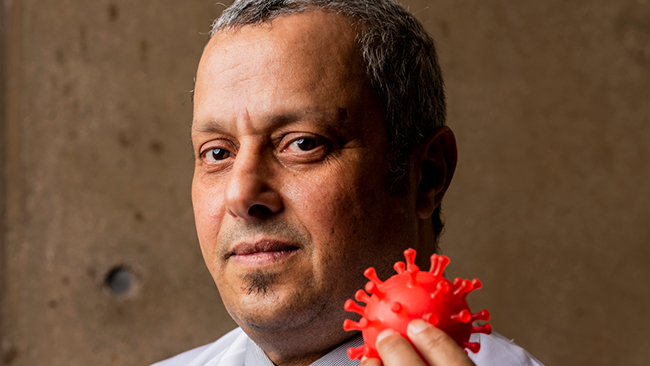
The Moroccan Professor of Immunology, Lbachir Benmohamed, the founder and the head of the Laboratory of Cellular and Molecular Immunology at the University of California, leads a scientific team to develop an effective vaccine against all variants of Coronavirus.
According to several statements of the Moroccan professor on US television channels, his team working on using a patch similar to nicotine patch as a vaccine against all variants of Coronavirus, even those who haven't appeared yet, instead of needle and syringe as a way of vaccinating which is being currently used with other COVID-19 vaccines.
However, the patch would be nailed on the arm in the same place where the needle is injected, but without any pain.
Lbachir said that the universal vaccine that he and his team are working on it has a similar composition to the vaccines developed by American pharmaceutical companies Moderna and Pfizer, the difference is other additional ingredients would be added which would allow it to be effective against any possible mutation of the Coronavirus in the future.
This vaccine is unlike Moderna and Pfizer vaccine, it doesn't need very cold storage temperature, and if it works, "you can put those patches in an envelope and ship them around the world," professor Lbachir BenMohamed said.
Lbachir and his team call this vaccine a preemptive coronavirus vaccine because it could be used in the future to address various mutations of related coronavirus proteins that come along.
This vaccine is now under animal experiments, as the Fox 11 Los angles channel reported, and the results of its efficacity could be announced in the few coming days.
Born in Morocco in 1968, Lbachir BenMohamed attended the primary school of his hometown of Tagante, a rural commune in Guelmim-Es Smara region in Southern Morocco.
In 1984 He got his Baccalaureate and was part of the first cohort of biology and Geology students of Agadir Ibn Zohr University. After his bachelor's degree in 1989, he moved to Paris where he received his Ph.D. in Immunology from the Pasteur Institute in 1997.
He flew to the US afterward and began his research career at UC Irvine where he became assistant Researcher, Research Fellow, Research Scientist Step I, Assistant Researcher Step IV, Assistant Professor of Immunology, Associate Professor of Immunology, and Professor of Immunology, Step I since 2014.