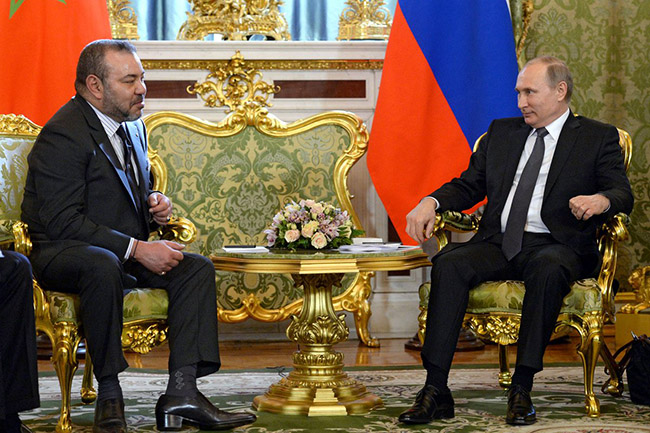
Russia is preparing to sign a bilateral agreement with the Kingdom of Morocco on the protection and promotion of investments, in a move that reflects Moscow’s desire to strengthen its economic presence in Africa and diversify its trade partnerships beyond traditional frameworks, following the signing of six similar agreements with other African nations.
According to the official website of the Russian Ministry of Economic Development, the upcoming signing of the agreement with Morocco is part of a broader Russian plan aimed at doubling trade with the African continent by a factor of 1.5 to 2 by 2030.
Pavel Kalmychek, Director of the Department for Bilateral Cooperation Development at the Russian Ministry of Economic Development, was quoted by the ministry’s website as saying that Africa is “one of the most promising regions in the world in terms of economic growth,” noting that Russia and the African continent are “natural partners in the fields of trade and economics.”
The Russian official explained that Moscow has placed the signing of a series of investment protection agreements with African countries among its top priorities for the coming period, including with Morocco, the Republic of the Congo, Mali, Nigeria, Tanzania, and Burkina Faso. He added that these agreements would provide a secure legal environment for investors and encourage the launch of joint projects in multiple sectors.
This Russian approach comes after trade exchanges between Russia and Africa exceeded $27 billion in 2024, according to figures from the Ministry of Economic Development, with North African countries accounting for nearly 70 percent of that total. Moscow is therefore seeking a greater balance in its trade relations with sub-Saharan African countries.
In recent years, Morocco and Russia have succeeded in significantly strengthening their economic relations. Official Russian data indicate that Morocco consolidated its position in 2025 as one of the main suppliers of fruits and berries to the Russian market.
According to data from the regional office of Rosselkhoznadzor, Russia imported a total of 1.3 million tons of fruits and vegetables through the ports of St. Petersburg and Leningrad region between January 1 and August 8, 2025, marking an 8 percent increase compared to the same period last year.
The same source reported that bananas topped the list of imports with 837,000 tons, followed by pears (84,000 tons) and mandarins (59,000 tons), while other varieties included apples, lemons, grapes, pineapples, and watermelons. Morocco—alongside South Africa, Egypt, Argentina, Pakistan, Ecuador, Costa Rica, Chile, Serbia, and Brazil—was among the main suppliers that strengthened their presence in the Russian market during this period.
As for vegetables, Russia imported 25,500 tons, including potatoes, carrots, cabbage, garlic, and beets, mainly from Belarus, Egypt, Pakistan, and China. Russian authorities confirmed that all these products underwent the necessary phytosanitary inspections and were approved for sale in local markets.
Morocco’s continued presence among the list of fruit and vegetable suppliers to Russia reflects the steady growth of trade relations between the two countries—especially as Russia itself announced last year that the value of its agricultural exports to Morocco had tripled.
The Russian Federal Center Agroexport revealed that the value of Russian agricultural exports to Morocco saw a remarkable increase in 2024, tripling to reach $280 million.
According to a report cited by the Russian news agency TASS, wheat was the main driver of this growth, with its export value rising 3.4 times compared to 2023. Russia exported over one million tons of wheat to Morocco in 2024.
The same source noted that Morocco resumed imports of sunflower oil from Russia after a hiatus of about five years, in addition to receiving shipments of oilseed meal (used in animal feed production) for the first time since 2015.
According to estimates by Agroexport, the potential value of Russian agricultural exports to Morocco could reach $350 million in the near future—reflecting a clear trend toward strengthening bilateral trade relations in the agricultural sector.
The rise in the value of Russian exports to Morocco coincides with a positive political climate between Rabat and Moscow. In December 2023, Russia’s Ambassador to Morocco, Vladimir Baibakov, praised Morocco’s stance on the Russia–Ukraine war, describing it as “balanced” and saying that Moscow “highly appreciates” this position.
The Russian ambassador added that, for his country, Morocco is “a friendly nation and a strategic partner.” He went on to say that “relations between our two countries have a special character and were strengthened through the agreements signed by President Vladimir Putin and King Mohammed VI in 2016.”
According to Baibakov, “these relations have proven resilient over time, including amid geopolitical fluctuations and financial and economic crises in recent years,” emphasizing that the two nations “continue to successfully enhance their trade and economic cooperation.”