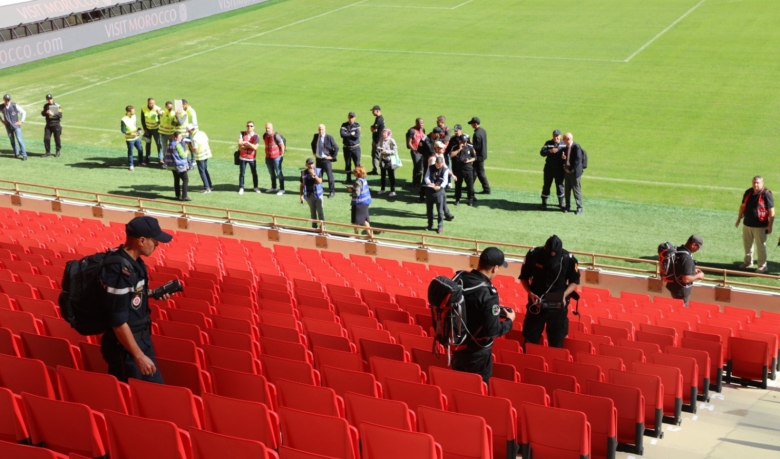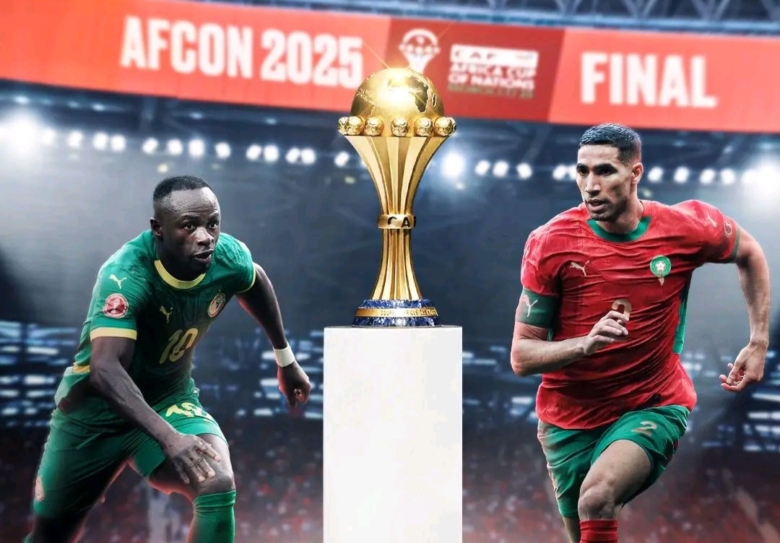
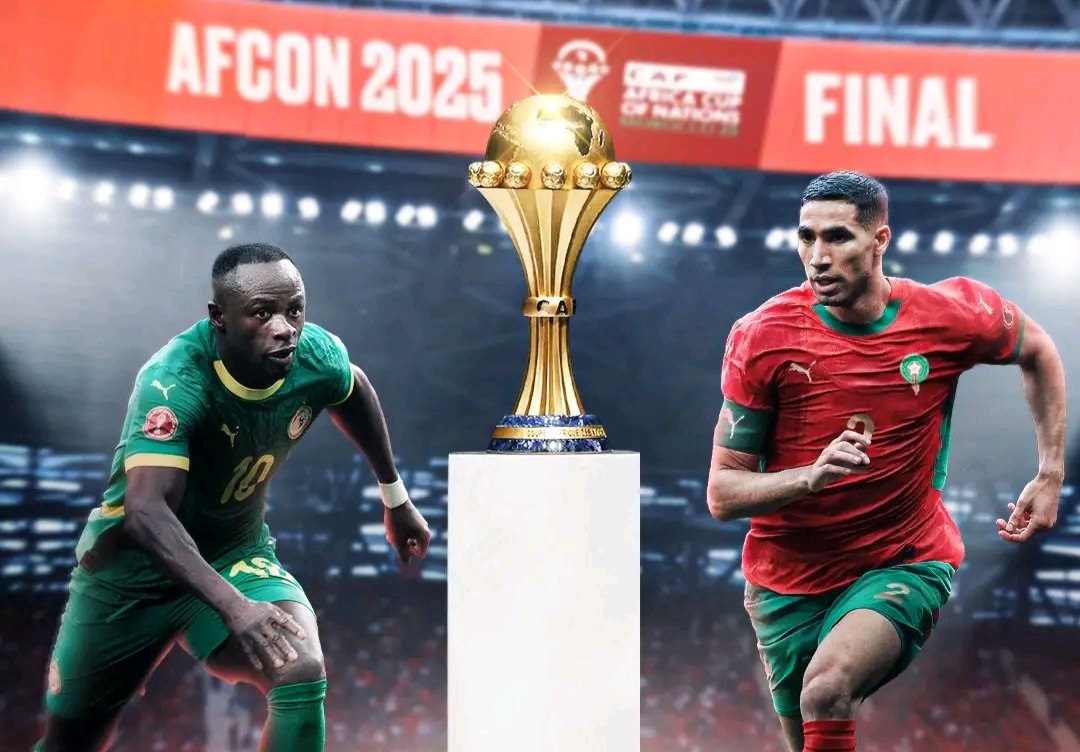
Football fans across Africa and beyond will turn their attention on Sunday evening to the Prince Moulay Abdellah Stadium in Rabat, where Morocco and Senegal face off in the final of the 35th Africa Cup of Nations, a showdown between two of the continent’s most dominant footballing forces of the past five years.
The final brings together two purely African football schools that have consistently delivered strong continental and international results across different age categories. For Morocco, playing on home soil, the match represents a historic opportunity to crown an exceptional tournament run with a long-awaited continental title. For Senegal, it is another chance to confirm their status as a reference point in African football.
Senegal’s “Lions of Teranga” arrive in Rabat after playing all six of their AFCON matches at the Grand Stade de Tanger, where they displayed remarkable tactical consistency and physical strength, backed by strong support from Senegalese fans and significant backing from Moroccan supporters. The team also benefited from high-standard accommodation and training conditions. However, the final now takes them into the heart of Moroccan territory, against the “Atlas Lions” and in front of a roaring home crowd.
From a statistical perspective, the final promises a finely balanced contest. Senegal boast the tournament’s second-best attack with 12 goals, behind Nigeria’s 14, and the second-best defence, having conceded just two goals. Morocco, meanwhile, arrive with the competition’s strongest defensive record, conceding only once, and the fourth-best attack with nine goals.
Throughout the tournament, Senegal have remained loyal to a 4-3-3 tactical setup built on a high defensive line, intense pressing, and physical dominance in midfield. This approach has been key to disrupting opponents’ build-up play and preventing fast transitions. Control of the midfield has allowed Senegal to launch aggressive attacks, particularly through wide areas, while quickly regrouping defensively when possession is lost.
However, the final will see Senegal without two key figures: captain and defensive leader Kalidou Koulibaly, and midfield anchor Habib Diarra, both suspended after receiving two yellow cards. Head coach Pape Thiaw has downplayed their absence, stressing that the squad includes 28 players who are fully prepared, both physically and mentally, for the final challenge.
Offensively, Senegal rely heavily on their wide players, with the experience and pace of Sadio Mané on the left and Iliman Ndiaye on the right, while striker Nicolas Jackson provides vertical runs and powerful finishing in the box. These attacking movements are often supported by midfielders pushing forward, before the team quickly drops back into a compact defensive block.
Morocco’s midfield, which impressed with its intensity and efficiency in the quarter-final and semi-final matches, will be under pressure to impose its rhythm on Senegal’s engine room. Much will depend on the performance of Azzedine Ounahi, Bilal El Khannouss and Ismael Saibari, supported by full-backs Achraf Hakimi and Noussair Mazraoui, as well as attackers Brahim Díaz and Abde Ezzalzouli. Head coach Walid Regragui is expected to opt for a setup that prioritizes closing spaces, applying high pressure, and ensuring rapid defensive transitions.
Tournament statistics underline the similarities in the playing styles of both teams. Senegal are the most prolific passing side in the competition, completing 3,084 passes with an 87 percent success rate. Morocco rank close behind, with 2,937 passes at an 86 percent success rate, placing them third overall after Nigeria. These figures reflect a shared emphasis on possession, midfield control, and aggressive pressing to force errors from opponents.
At 33, Sadio Mané is set to play his third AFCON final in five tournament appearances. After losing the 2019 final and winning the title in 2021, the Senegalese star has hinted that this could be his last continental final. His role goes beyond scoring, as he provides balance between Senegal’s attacking threat and defensive effort. Mané has taken 12 shots in the tournament, scoring twice and providing three assists, highlighting the challenge facing Morocco’s right flank, particularly Achraf Hakimi, in containing his constant forward surges.
Despite Senegal’s attacking firepower, breaking down Morocco’s defensive structure has proven difficult for every opponent so far. Under Regragui, the Atlas Lions have built a formidable defensive unit, keeping five clean sheets in six matches. Goalkeeper Yassine Bounou has conceded just once, from a penalty, shielded by the solidity of central defenders Nayef Aguerd and Adam Masina, the pace of Hakimi and Mazraoui, and strong midfield support.
Yet Senegal’s strength does not rest solely on Mané. Their 12 goals at AFCON 2025 have been scored by eight different players from various positions, including defenders, midfielders and forwards, reflecting a diverse and unpredictable attacking approach built on set pieces, counter-attacks, wing play and aerial deliveries.
With more than 60,000 supporters expected to fill the stands in Rabat, Morocco’s Atlas Lions will count on the fighting spirit they displayed in a memorable semi-final victory over Nigeria. On home ground, and driven by the dream of continental glory, Morocco know that lifting the AFCON trophy will require containing and taming Senegal’s Lions of Teranga in what promises to be a high-intensity African football classic.