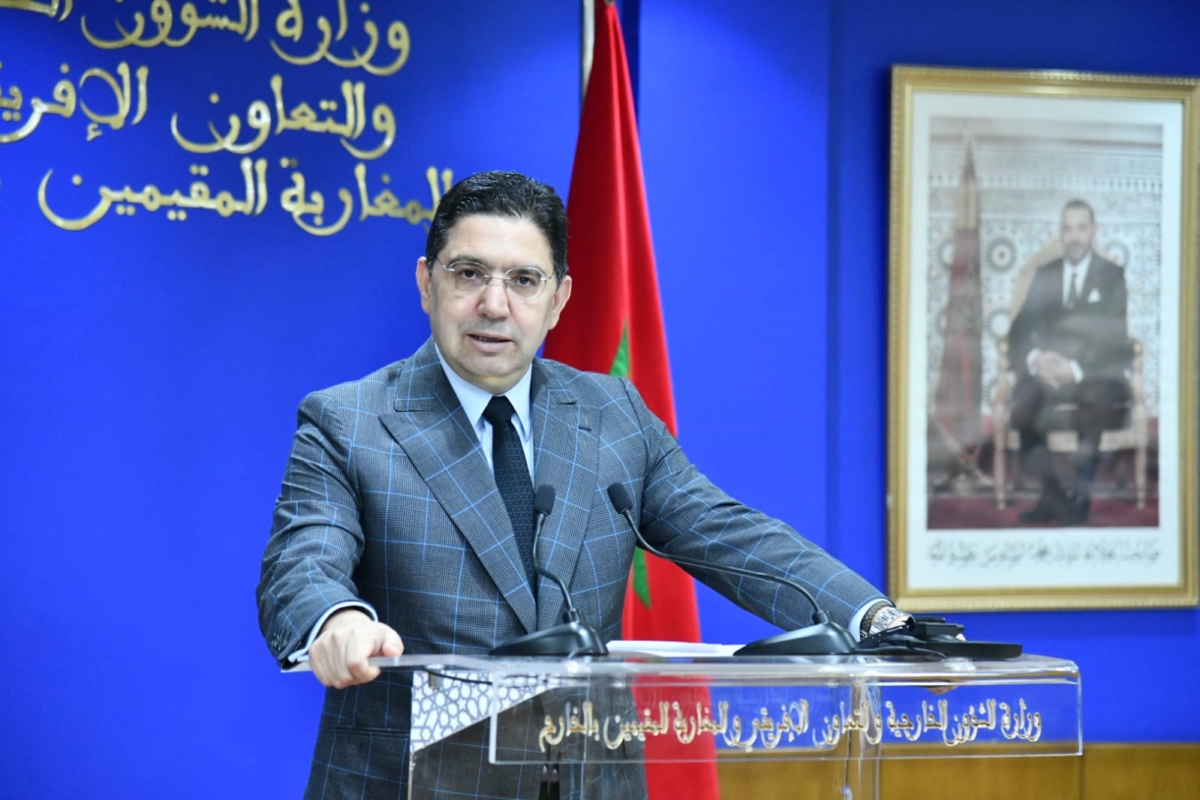
Morocco has been engaged for the past 25 years in an “irreversible march” toward gender equality under the leadership of King Mohammed VI, said Minister of Foreign Affairs, African Cooperation, and Moroccan Expatriates Nasser Bourita, during the 4th Conference on Feminist Foreign Policies held on Wednesday in Paris.
Speaking before foreign ministers and representatives from nearly fifty countries, including France’s Jean-Noël Barrot and Spain’s José Manuel Albares, Bourita highlighted that Morocco’s reforms “have not only changed the letter of the law but have also transformed the mindset of a generation,” paving the way for “a society that recognizes equity as the foundation of its modernity.”
He stressed that Morocco’s progress stems from a clear royal vision: “Our confidence stems from His Majesty King Mohammed VI’s decision to place women’s rights and equality at the center of His reign,” Bourita declared, underscoring that Morocco’s advances are both constitutional and societal.
The minister underlined that Morocco’s domestic transformation has naturally extended to its diplomacy, giving rise to what he described as “feminist diplomacy”—a diplomacy “in the service of peace.” He recalled that in 2022, Morocco adopted its first National Action Plan to implement UN Security Council Resolution 1325 on Women, Peace, and Security, which has since been extended through 2026.
“Women are now placed at the heart of prevention, mediation, and reconstruction efforts,” Bourita said, noting that Morocco currently ranks as the ninth-largest contributor to UN peacekeeping operations, with 3,400 troops deployed, including 120 women.
The minister emphasized Morocco’s proactive approach to consolidating peace across Africa, pointing to the Kingdom’s training of female mediators—“women on the ground who embody close-proximity diplomacy, defusing tensions and rebuilding trust within communities.”
He also cited Morocco’s work with the African Union to train electoral observers, noting that from 2022 to 2025, 175 women out of 300 observers were trained by Morocco as part of its commitment to promoting women’s participation in democratic processes.
Bourita extended Morocco’s feminist diplomacy to the religious and social spheres, describing them as “essential levers of stability.” He recalled that women account for nearly half of regular immigrants in Morocco, highlighting that the country’s migration regularization campaigns of 2014 and 2017 offered protection and dignity to thousands of women—“a reflection of a diplomacy that rejects exclusion,” he said.
At the UN Human Rights Council in Geneva, Morocco sponsored a landmark resolution in April on “Women, Diplomacy, and Human Rights,” which strengthened the International Day of Women in Diplomacy and called on states to ensure equal access to diplomatic positions.
“Feminist diplomacy also defines our bilateral relations,” Bourita said, citing Morocco’s partnerships with France and Spain, where gender equality is a pillar of political dialogue, as well as with Japan and several Latin American countries under the Women, Peace, and Security agenda.
He argued that women’s inclusion enhances collective performance: “In peace negotiations, women’s participation increases the chances of lasting agreements; in economics, closing the gender gap could boost global GDP by more than 20%,” he said, referencing World Bank data.
He also drew a direct link between gender equality and stability, noting that “studies show an inverse correlation between equality and radicalization: the more egalitarian a society, the less it is exposed to extremist drifts.”
Bourita further connected gender equality to the fight against climate change, explaining that “investing in equality could reduce global greenhouse gas emissions by up to 15% by 2050.”
“Because feminist diplomacy cannot be deployed externally without internal consistency,” Bourita continued, “we have chosen to open up our own diplomatic apparatus to female talent.” Today, 43% of the Ministry’s staff are women, 47% hold senior positions, and 29% of Morocco’s diplomatic and consular missions are headed by women.
He emphasized that these achievements were not the result of quotas but of merit: “It is not a matter of balancing numbers but of doing justice through high standards—and women have never failed to deserve it,” he affirmed.
Concluding, Bourita called for collective global action through the Feminist Foreign Policy Group (FFP+), proposing a joint training program for feminist diplomacy and the Women, Peace, and Security Agenda, as well as the creation of shared platforms for exchange among women diplomats worldwide.
“Feminist diplomacy is not a model to be exported,” he said, “but an experience to be shared—one that Morocco, under the leadership of His Majesty King Mohammed VI, is proud to contribute to.”