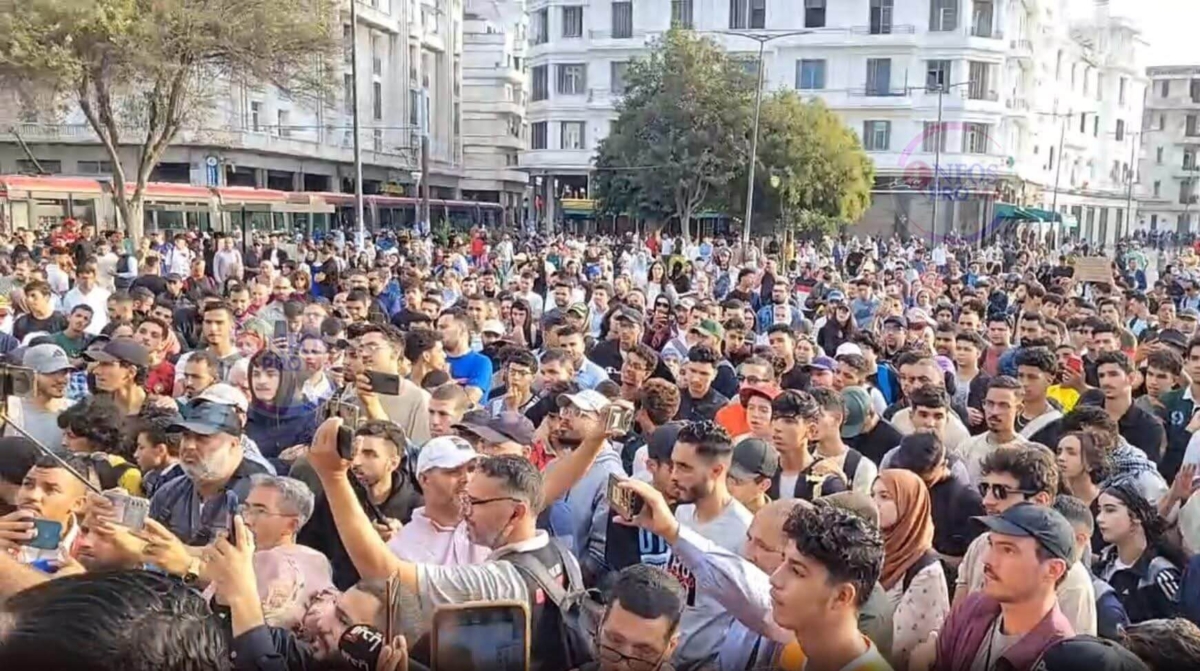
The President of Morocco's National Human Rights Council (CNDH), Amina Bouayach, held an extended meeting on Wednesday with the presidents of regional human rights commissions, along with directors and mission officers at the Council’s presidency, to assess recent youth-led protests across the country and discuss ways to strengthen the Council’s mechanisms for observation, monitoring, and intervention.
According to a statement, the CNDH deployed observation and monitoring teams from the onset of protest calls, working at three levels: regional, through its commissions in the Kingdom’s twelve regions; national; and digital. These efforts were accompanied by communication on the ground with local authorities and young people at protest sites.
The Council noted that Morocco’s digital space has become a field of freedoms where young people express new values and engage in civic participation, stressing that the initial demonstrations were peaceful before some were marred by violence. Reported incidents included stone throwing, looting, car fires, destruction of property, and what it described as inappropriate or inadequate interventions.
The CNDH underlined the importance of guaranteeing the right to peaceful assembly as a democratic achievement, calling for shared responsibility between protest organizers and public authorities to maintain order while safeguarding freedom of expression and assembly. It also stressed that a human rights–based interpretation of peaceful assembly should apply regardless of prior authorization or notification, especially in light of emerging forms of digital mobilization.
The Council emphasized the need to protect both citizens and law enforcement from violence, reaffirming its position that peaceful assembly is a universal right distinct from violent gatherings, which international human rights mechanisms prohibit.
As part of its monitoring, the CNDH reported detecting numerous online expressions involving misinformation, incitement to violence, calls to burn public institutions, and threats targeting officials’ residences, including explicit calls for liquidation. It also flagged violations targeting citizens rejecting violence or choosing not to participate in demonstrations, noting that many of these accounts appeared recently created or foreign-based.
On Wednesday evening, the Council confirmed that protests were recorded in several cities, including Salé, Errachidia, Dakhla, Taroudant (Leqliaa), and Rabat, with significant participation by minors. While most demonstrations remained peaceful, some witnessed serious violence.
The CNDH expressed deep regret at the deaths of three people in Leqliaa, in the prefecture of Inezgane-Ait Melloul, as well as the injuries sustained by both protesters and law enforcement. It took note of the official statement released regarding the shooting deaths and welcomed the release of many detained protesters. However, it condemned attempts to storm and set fire to the Royal Gendarmerie center in Leqliaa, stressing that families lived inside the building.
Calling for investigations into violations of the right to life and physical integrity, the Council pledged to continue monitoring operations, trial observation, and field interventions.
Extending condolences to the families of the deceased, the CNDH reaffirmed its commitment to remain open to dialogue and expression, with the goal of ensuring the effective exercise of rights and freedoms for all citizens.