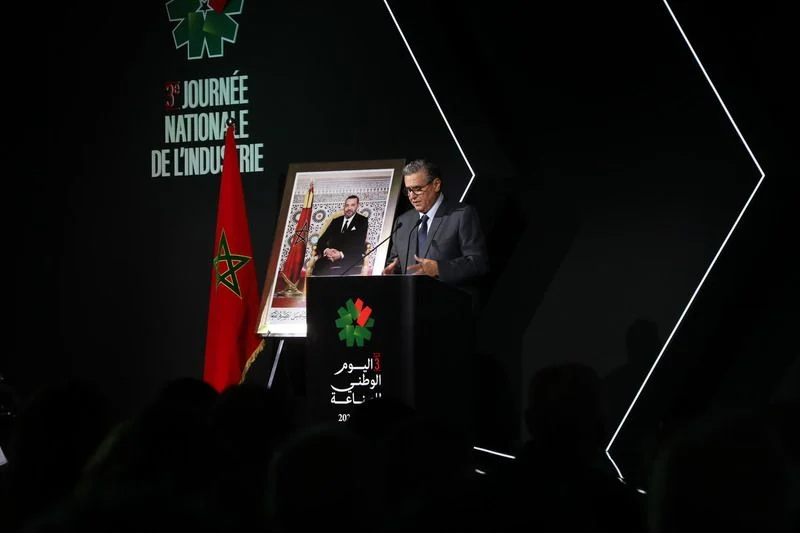
The “Made in Morocco” label has become a strategic lever for strengthening the Kingdom’s position as a competitive industrial destination, Prime Minister Aziz Akhannouch said on Monday at the opening of National Industry Day in Rabat.
Speaking at the event, organized by the Ministry of Industry and Trade in partnership with the General Confederation of Moroccan Enterprises (CGEM), Akhannouch highlighted the “remarkable growth” of Morocco’s industrial sector in recent years, crediting the vision of King Mohammed VI for ushering in a “new era” built on the concept of sovereignty as both an objective and a means.
The Prime Minister noted that Moroccan industry has made significant strides, particularly in high value-added sectors such as automotive and aeronautics. The automotive ecosystem, he said, has become Morocco’s leading export sector—representing around 40% of industrial exports—and the largest industrial employer, accounting for nearly a quarter of all industrial jobs.
“Morocco is now Africa’s leading producer of passenger cars and the main exporter of internal combustion engine vehicles to the European Union,” Akhannouch said.
He added that the Kingdom is now investing heavily in electric mobility, building a fully integrated value chain from raw materials to battery assembly, with several flagship projects reflecting growing international confidence in Morocco’s industrial platform.
The aeronautics industry, meanwhile, continues to expand, with over 150 active companies and exports up by more than 61% in 2024 compared with 2021. Akhannouch recalled the inauguration by King Mohammed VI in October of an aircraft engine industrial complex in Casablanca—one of several major new projects reinforcing Morocco’s position in global value chains.
In the pharmaceutical sector, Morocco has established a cutting-edge vaccine manufacturing facility and signed new agreements to develop local production of pharmaceutical raw materials. “This will help strengthen Morocco’s health sovereignty and consolidate its role as a regional hub for pharmaceutical production,” Akhannouch said.
The Head of Government also pointed to Morocco’s rise in international rankings, noting that the Kingdom placed 12th globally in 2025 for industrial production with medium and high technological content, according to the World Intellectual Property Organization’s Global Innovation Index—its best performance in five years.
To sustain this momentum, Akhannouch said the government is pursuing initiatives to boost industrial sovereignty and competitiveness. The Industrial Project Bank, for example, has attracted over 1,900 projects, while a new research and innovation program launched with the CGEM has funded 160 projects worth nearly MAD 852 million since 2023.
He also underscored Morocco’s commitment to clean energy, noting that the country’s energy transition strategy aims to ensure carbon-free production and enhance industrial competitiveness through access to renewable resources, including green hydrogen.
“Morocco is betting on energy transition as part of the ‘Morocco Offer,’ which has already drawn the interest of leading global players,” Akhannouch said.
Concluding his remarks, the Prime Minister emphasized that industry remains central to Morocco’s employment strategy and economic growth. “This National Industry Day is an opportunity to exchange ideas and design new mechanisms to strengthen our industrial base and address future challenges,” he said.
Held under the High Patronage of King Mohammed VI, the third National Industry Day runs until November 4 under the theme “Made in Morocco: a mark of quality, competitiveness, and a lever for integrated regional development.”