When the Royal Palace announced the death of King Hassan II on July 23, 1999, Moroccans found themselves caught in a psychological war waged by foreign media, particularly the French press, which sought to frame the image of the young monarch through the lens of the French state rather than that of his own country.
At that time, Paris’s main approach was to reinforce the idea presented in Gilles Perrault’s book “Our Friend the King,” while Le Monde devoted lengthy reports to the personality of the “new sovereign.” One of its issues on post-Hassan II Morocco wrote: “Mohammed Ben al-Hassan, who after the oath of allegiance becomes King Mohammed VI, known as a ‘shy king’ and not as strict as his late father, faces two major challenges: the strong rise of Islamists and the army.”
Meanwhile, the Moroccan street was discovering the King who succeeded his father through personal photos sold by vendors on the sidewalks of Mohamed V Avenue in Rabat, Casablanca, Tangier, Nador, and Al Hoceima. A King pictured at the swimming pool with a black dog beside him. A King smiling while holding a glass of Moroccan tea. A King hugging a woman from the people who crossed his path to embrace him. A King dressed in ski clothes, looking toward the horizon from behind his black sunglasses. This was how the Palace chose to respond to foreign campaigns that wanted “a king made to their measure,” in order to avoid their defeat before the charisma and shrewdness of Hassan II.
These were not just personal pictures of a King known to the people only through his official image as Crown Prince, but rather a demolition of the Palace walls that had ensured its secrets remained confined within, far from public gossip, private talk, and the eyes of foreigners.
A New King, A New Communication
Weeks after taking power, rumors spread that King Mohammed VI had been the target of an “assassination attempt,” and that his personal bodyguard, Aziz Jaidi, had been killed while trying to shield the King with his body. Yet on the same day, Mohammed VI appeared on the main news bulletin of Channel One, with his bodyguard Jaidi alive and standing behind him.
It was a policy of symbols, a “communication of the unspoken,” that the Palace chose in the era of Mohammed VI, as a response to the disinformation wars waged against the monarchy as the symbol of Morocco’s system of governance, with any attack on it being in fact an attack on the first guarantor of the Kingdom’s stability.
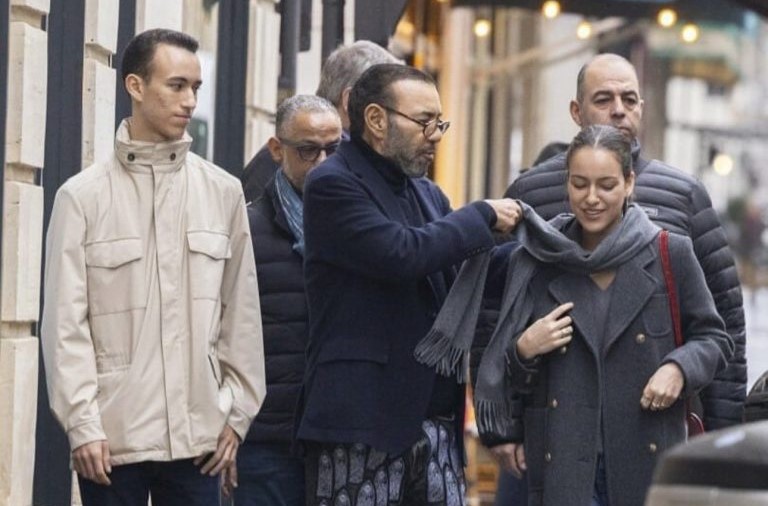
Not only that, this communication policy also served to strengthen the King’s bond with citizens. This explains the publication of photos of the King visiting a remote area during the rainy season, sinking his feet into the mud without any concern for strict royal protocol. Likewise, photos of him on the tifour at his wedding like any Moroccan groom enjoying his celebration, holding his son in his arms, or playing with his daughter.
The King who appears in traditional djellaba during religious holidays, performing prayers, listening to the preacher during the Ramadan lectures, and presiding over official banquets to welcome presidents, kings, and princes, is the same King who poses for selfies with citizens stopping him in the street, or who does not hesitate to take pictures at the request of members of the Moroccan community in Amsterdam, waiting outside his hotel to capture a photo with him, as if he were a “star” adored by the public, not just a traditional monarch.
From Image to Social Media
With the transition of images to social media, the Palace’s communication policy also shifted to these platforms, publishing photos of the King driving his own convertible car, accompanied by his advisor Fouad Ali El Himma, by Crown Prince Moulay Hassan, by Princess Lalla Khadija, or by his brother Prince Moulay Rachid.
In fact, Moroccan citizens themselves became “royal correspondents,” spontaneously capturing and sharing the King’s movements as he lived like any Moroccan citizen. Social media platforms abound with videos of Mohammed VI waiting at a red light, riding the waves on his jet ski and waving to vacationers swimming nearby, showing that it was not only the Palace adopting flexible communication methods in step with the evolution of new platforms, but also the Moroccan people themselves embracing these methods, using them to express their close bond with the monarchy.
The truth is that the policy of symbols, imagery, and the unspoken was not only a shield against foreign disinformation campaigns but also against rumors that sometimes emerged within Morocco itself, often with good intentions. This was the case during the COVID-19 pandemic, when the Palace countered fear and skepticism about the vaccine by showing King Mohammed VI wearing a mask and extending his arm to receive an injection of the Chinese vaccine, which was the most available and accessible to the general public.
But today, as we face a new wave of “war” through disinformation media, with attacks orchestrated by a single maestro—whether under the name of the French newspaper Le Monde, the “Jabroot” platform on Telegram, or the blatant targeting of the Moroccan sovereign and his heir, Crown Prince Moulay Hassan—the following question must be asked: If Morocco acts with composure and self-confidence because it is not only a country of institutions, but a state that derives its legitimacy, strength, and even its aura of mystery from twelve centuries of historical accumulation, is it not time—now, not tomorrow—for a constitutional media institution whose ultimate goal would be to achieve “media immunity” through what is known as “deterrence media” as one of the most important foundations of national security for any country?
To answer this question, and to demonstrate the danger of Morocco’s persisting weakness—namely, the absence of public media from the field, and the confinement of journalism to the narrow notion that “good journalism is opposition to the state”—we must first address the following: What is disinformation media? Why and how do foreign intelligence services resort to it in order to wage psychological wars against a rival state? And the bigger question: Why do foreign intelligence services wage disinformation wars against the monarchy in particular? And what is the connection between Morocco’s global reserves of phosphate and uranium, and the campaigns of Le Monde in France or Jabroot on Telegram?
In his famous book Active Measures: The Secret History of Disinformation and Political Warfare, American author Thomas Rid recounts the most important case study in teaching “disinformation media”: the so-called “Westmoreland Field Manual.” Rid explains that in 1975, a local Turkish newspaper called Barış published a document it described as secret, labeled FM30-31, which later became known as the “Westmoreland Field Manual,” after William Westmoreland, the commander of U.S. forces in the Vietnam War and later Chief of Staff of the U.S. Army. The newspaper claimed the document was a secret military manual bearing Westmoreland’s signature, outlining U.S. strategy in Vietnam, and allegedly detailing the Army’s plan to carry out malicious activities in America’s allied states to destabilize them, suppress leftist movements, or prevent leftists from coming to power.
The document spread like wildfire across global media, embraced by leftist regimes as evidence of the “filth” of capitalist ideology, liberal democracy, and the United States itself, which, according to the document, did not hesitate to sow chaos even in friendly and allied countries, not just its adversaries.
In reality, the document was “classic disinformation” used by intelligence agencies against their adversaries. Its credibility was enhanced by the Turkish newspaper’s failure to cite a source, creating the illusion that it had been leaked directly from the U.S. Army. But what made this particular disinformation operation a landmark in the teaching of “disinformation media” was the innovation of what became known as “planted disinformation”: Soviet intelligence had deliberately chosen a newspaper in a third country to attack the United States, thereby avoiding publication in its own Moscow-based outlets.
The United States launched an investigation into the document’s authenticity, and in 1976 concluded that it was a forgery originating from the Soviet Union. Yet this did not diminish its impact or stop its circulation in international media. In fact, it continued to be republished in leftist newspapers around the world for years, well into the 1980s, until a number of intelligence officials defected from the Soviet Union and sought asylum in Washington. It was then revealed that the “Westmoreland Field Manual” was nothing more than a fabrication produced by the KGB, part of an intelligence methodology the Soviets had institutionalized under the name Active Measures. These same defectors disclosed that the Soviet Union had even chosen a French word, Aisinformation, as a counter-intelligence term, to give the false impression that the operation was being carried out by French intelligence.
Disinformation is neither a creation of journalism nor a byproduct of the Cold War; it has existed since the birth of states and the founding of empires. In the rivalry between the Roman and Byzantine Empires, false messages were used to spread panic within enemy ranks. Meanwhile, Islamic empires, including the Ottomans, relied on mosque pulpits and Friday preachers to influence congregations through exaggerated sermons aimed at vilifying adversaries.
With the invention of the printing press and the rise of journalism in Europe, disinformation took on new dimensions. During the French Revolution, pamphlets circulated containing false claims about Queen Marie Antoinette. Even the infamous phrase attributed to her—when told that the people were starving because they lacked bread, she supposedly replied, “Let them eat croissants”—was a piece of disinformation. Historians insist she never uttered those words; they were ascribed to her deliberately to inflame public anger.
This calls to mind both the “Let them eat croissants” episode and the phrase “grind him”, which spread after the tragic death of fishmonger Youssef Fikri in Morocco’s Rif region. It was rumored that a police officer had ordered his killing with the words “grind him.” The phrase quickly circulated among the outraged, then moved onto social media platforms where it was repeated as fact, with no one daring to question its authenticity or to call for verification.
In both World War I and World War II, disinformation became an industry of enormous scale, with propaganda elevated to unprecedented levels. Hitler’s allies, under the direction of propaganda chief Joseph Goebbels, famously adopted the slogan: “If you tell a lie big enough and keep repeating it, people will eventually come to believe it.” Strikingly, this very slogan seems to guide the French newspaper Le Monde today in its relentless targeting of the Moroccan monarchy.
During the Cold War, propaganda gave way to what became known as “intelligence disinformation,” a battleground dominated by the American CIA and the Soviet KGB, relying heavily on newspapers—just as in the case of the “Westmoreland Field Manual.”
In the 21st century, the world has witnessed a new form of disinformation: digital disinformation. With the advent of the internet and social media, no printing presses or radio stations are required. A single hashtag or a fabricated video is enough to reach millions, who often consume such content as absolute truth.
Nothing happens by coincidence in the world of disinformation journalism
Today, as Morocco prepares to co-host the 2030 World Cup alongside Spain and Portugal, it faces a new giant: artificial intelligence. This raises a legitimate question: with such a stagnant, lifeless, and incapable public media system—unable to keep pace with the expectations of Moroccan audiences or the evolution of journalism—how can Morocco confront the challenge of artificial intelligence and the hostile actors who use it to sow confusion against the state and its citizens?
Looking back at the “Westmoreland Field Manual,” or FM30-31B, one can understand the disinformation wars waged against Morocco—particularly its monarchy—throughout the 26-year reign of King Mohammed VI. These wars can be divided into three categories.
The first is direct disinformation warfare, often orchestrated by Algerian intelligence, which openly displays hostility toward Morocco under the military regime led by Chief of Staff Saïd Chengriha. This strategy focuses on two themes: tarnishing the image of the King by spreading false reports about his health or activities abroad, often exaggerating claims of illness; and denigrating the Moroccan people by portraying them as impoverished, destitute, and desperate “ḥarrāga” (irregular migrants) willing to throw themselves into the Mediterranean to escape Morocco.
At times, this kind of direct disinformation is employed by so-called friendly or allied states. For instance, Saudi Arabia’s “Al Arabiya” once falsely reported during the COVID-19 pandemic that Moroccans were suffering from “famine.” Similarly, “Sky News Arabia,” based in the UAE, published a map of Morocco without its Sahara. But it is the French newspaper Le Monde, along with certain right-wing Spanish outlets, that has most consistently engaged in direct disinformation warfare against Morocco—usually to defend economic interests or curb Morocco’s rising influence in Africa. Ultimately, these campaigns reflect an alignment of political and economic agendas.
The second category is planted disinformation warfare, which itself can take three forms. The first involves one state using the press of another country to attack a third—just as with the “Westmoreland Field Manual.” The second occurs when the initiating country is not hostile but rather an ally, using disinformation to protect its own interests against those of a rival state. A clear example is the Qatar–UAE rivalry: Qatar relies on its openly partisan media arsenal, while the UAE, despite owning or influencing multiple outlets worldwide, has comparatively weaker media impact. This makes its involvement in planted disinformation easier to expose.
Another example is the campaign of articles targeting the Moroccan monarchy launched by Le Monde in August 2025. This cannot be seen merely as an act of the French “deep state,” making it different from direct disinformation. Unlike in King Hassan II’s era, when Le Monde was considered the mouthpiece of France’s deep state, the paper today is funded by an ostensibly independent trust composed of business leaders, both French and foreign—including Gulf investors.
The third, and most dangerous, form of planted disinformation is when a foreign government secretly acquires shares—or even full ownership—in a newspaper abroad, concealing the transaction. The UAE has done this in several Arab countries and even attempted it in the UK when it tried to take over The Daily Telegraph. The British government intervened, passing legislation to prevent foreign state ownership of newspapers under “national security” grounds.
This type of planted disinformation is also known as “dark investment.” Here, the true buyer remains hidden: sometimes it is a government acting through a private company, sometimes a corporate front for criminal networks with political and economic clout seeking media cover against rivals, including the host state itself. Often, it is an intelligence agency aiming not only to manipulate public opinion or spread disinformation but also to use the newspaper as a cover for hostile espionage operations against the host country.
The Digital Disinformation War
This war, which emerged with the advent of social media platforms, was first waged against Morocco on YouTube, Facebook pages, and Twitter hashtags. Today, however, it is increasingly fought on Telegram, a platform headquartered in Dubai and owned by Russian-born Pavel Valeryevich Durov—who also holds Emirati and French citizenship. Often described as a “battlefield,” Telegram has been transformed from a mere platform into a weapon for certain states, frequently those whose nationalities are held by its owner. This makes it legitimate to piece together the narrative in the following manner.
If the “Jabaroot” page operates on Telegram—a platform based in Dubai, in a country officially described as a brotherly state to Morocco, and whose owner holds Emirati and French citizenship—and if the “attack” on Morocco began at the same time as Le Monde’s disinformation war against the monarchy, then can these interlinked threads provide the background for understanding the insults directed at the Moroccan King and his Crown Prince?
If we consider how Le Monde framed its campaign against the Moroccan monarchy, it becomes clear that the newspaper treats Morocco’s monarchy as though it were a replay of the Louis XIV and Marie Antoinette story—as if post-Macron France seeks to dismantle Morocco’s monarchy in order to curb its growing presence in Africa and punish its independent stance on the Sahara issue and other dossiers no longer under French control.
Similarly, when examining “Jabaroot’s” methods, we find them reminiscent of Soviet intelligence tactics—particularly the fabrication of “leaked” documents presented as secret. This mirrors the “Westmoreland Field Manual” incident, when a Turkish paper published a document purportedly from the U.S. military, which was in fact a forgery. The question, then, is: why does “Jabaroot” employ methods typical of Soviet intelligence? Is this tied to the Russian origins of Telegram’s founders, the very platform used to wage this campaign against Morocco?
Over the 26 years of King Mohammed VI’s reign, foreign opinion polls have consistently shown the same result: Moroccans place their trust in three institutions—the monarchy, the military, and the security apparatus. This explains why disinformation campaigns, particularly those rooted in intelligence operations, have persistently targeted these very institutions. The first target is typically the security establishment, as seen in the attacks on Abdellatif Hammouchi, head of both the General Directorate for National Security and the General Directorate for Territorial Surveillance.
After the security sector, the military is attacked. When both efforts fail, the campaign invariably shifts toward its true objective: the monarchy itself and the King personally. This is because he is not only the head of the monarchy and the state but also the symbol of Morocco’s stability and the ultimate source of reassurance for its citizens.
For this reason, intelligence-driven disinformation campaigns against the monarchy have often focused on the King’s health. Even though the Royal Palace has been transparent for 26 years in releasing bulletins about the King’s medical updates—acknowledging his illnesses, health setbacks, psychological struggles, and surgeries, much like any ordinary citizen—the subject remains a favored theme for disinformation. Digital disinformation campaigns have gone so far as to circulate doctored videos claiming that the King celebrating Eid al-Adha was not him but a lookalike, including footage of a supposed double performing the sacrificial slaughter.
Nor was this the only form of disinformation faced by the royal family. Every time the monarchy opened itself to the people outside palace walls, disinformation operatives sought to punish it, to push it back into isolation, and to monopolize the narrative surrounding the monarchy. The goal has been to construct a tale akin to that of Louis XIV and Marie Antoinette, allowing disinformation actors to preserve their interests in Morocco by attempting to control the ruler himself.
King Mohammed VI’s marriage, the unprecedented public appearances of his wife, and the royal wedding ceremony conducted with the same customs as any Moroccan couple’s—while signaling a positive step toward modernity—provoked a ferocious disinformation campaign cloaked in the language of “democracy and freedom of expression.”
When a Spanish newspaper reported Princess Lalla Salma’s separation from King Mohammed VI—later confirmed by a French lawyer who often represents the palace—Moroccans reacted with composure, recognizing her enduring role as the mother of the Crown Prince. Life went on, both for the people and for the King, and attempts to destabilize Moroccan society through the news collapsed. What might once have been seen as a social crisis was instead absorbed as part of life in Mohammed VI’s Morocco.
Nevertheless, Princess Lalla Salma was not spared from disinformation. She became the target of every form of attack—direct, planted, and digital—through fabricated rumors about her safety, health, and wellbeing. This underscores the persistence of disinformation actors in reviving the story of Louis XIV and Marie Antoinette, attempting once again to destabilize the Moroccan state with “croissant journalism.”