
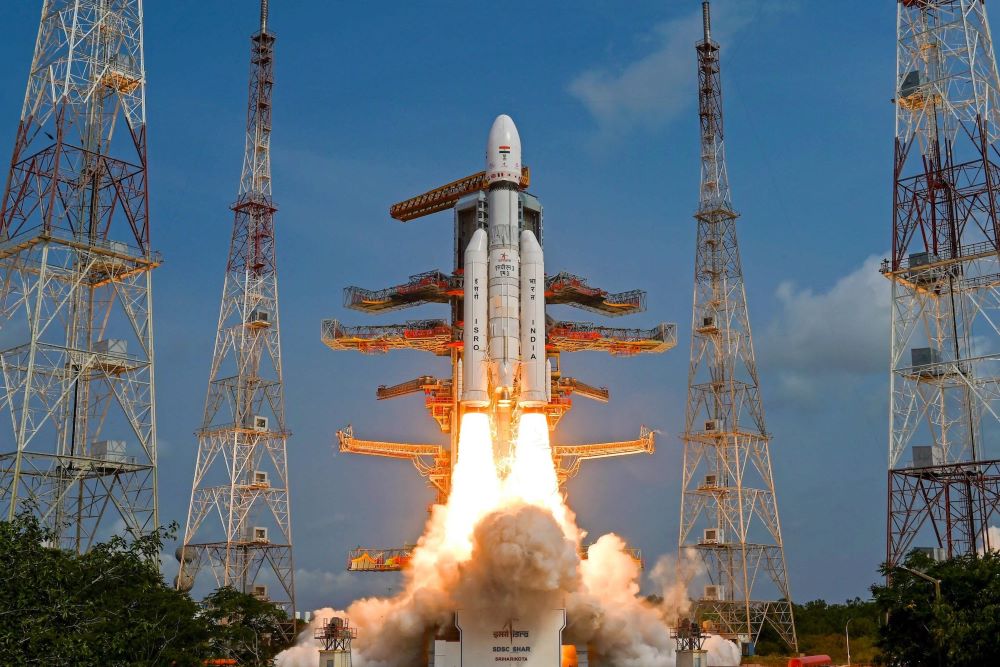
India and Morocco have taken practical steps to strengthen their bilateral cooperation in the peaceful uses of outer space, following the signing of a Memorandum of Understanding (MoU) between the two sides in New Delhi, India, on September 25, 2018, which officially entered into force in 2019.
This strategic track was confirmed by senior officials from the Indian Space Research Organisation (ISRO) during a roundtable discussion held on June 16, 2025, at the agency's headquarters in Bengaluru. The event was attended by a delegation of international journalists and chaired by Ganesh Pillai, the Scientific Secretary at ISRO. It highlighted aspects of India’s technical and scientific cooperation with African countries, including Morocco.
In response to a question from Assahifa English regarding the evolution and nature of India’s space cooperation with Morocco, ISRO officials stated that India and Morocco had signed a Memorandum of Understanding (MoU) in this field, which officially came into effect in 2019. The agreement aims to strengthen cooperation across multiple domains, including space science, technology, and applications, particularly remote sensing, satellite communications, satellite-based navigation, planetary exploration, and the development and use of space and ground systems.
The implementation of the agreement is to be overseen by a Joint Working Group composed of experts from the Indian Department of Space, ISRO, and Moroccan representatives from the Royal Centre for Remote Sensing (CRTS) and the Royal Centre for Space Research and Studies (CRERS), with the goal of setting a practical roadmap and timeline for joint projects.
In their comments to Assahifa English, ISRO officials described the cooperation with Morocco as one of the most promising experiences in Africa. They noted that several activities had taken place since 2019, including an Earth Observation (EO) Workshop organized in 2021, which involved Moroccan officials and focused on the use of satellite imagery in agriculture and natural resource management.
Four Moroccan officials have also benefitted from specialized training programs at the Indian Institute of Remote Sensing (IIRS) and through the CSSTEAP (Centre for Space Science and Technology Education in Asia and the Pacific), in addition to their participation in the UNNATI program, which India launched to train professionals from developing countries in the design and operation of small satellites.
ISRO officials stressed that the current phase of cooperation is centered on space applications, pointing out that countries without launch infrastructure can still derive direct and tangible benefits by using satellite data for sustainable development, disaster response, and the improvement of agricultural and water services—areas where ISRO provides strong support.
They emphasized the need to prioritize space application development before moving toward more complex projects like satellite manufacturing or launching, asserting that this approach enables emerging countries to make rapid and effective gains from space capabilities.
This partnership with Morocco and other African countries aligns with India’s broader ambition to assert itself as a rising space power, reflecting its growing openness to international cooperation—especially with Global South nations—within a multidimensional strategy that blends research, applications, and development.
In this context, India is pursuing ambitious medium- and long-term goals, including sending its first astronaut into low-Earth orbit on a crewed mission under the Gaganyaan program in the near future. Four Indian Air Force pilots have already been selected and trained for the program’s initial phase.
India also plans to carry out its first crewed lunar mission by 2040, as announced by Prime Minister Narendra Modi, who reaffirmed the government’s commitment to providing the financial and technical support needed to realize this national vision. The plan includes multiple stages, such as building an Indian space station in Earth orbit by 2035.
ISRO is currently developing a next-generation launch vehicle and expanding its navigation, communications, and data infrastructure to enable it to undertake more ambitious crewed missions over the next two decades in a global race that now includes the United States, China, and India—all looking toward the Moon and beyond.