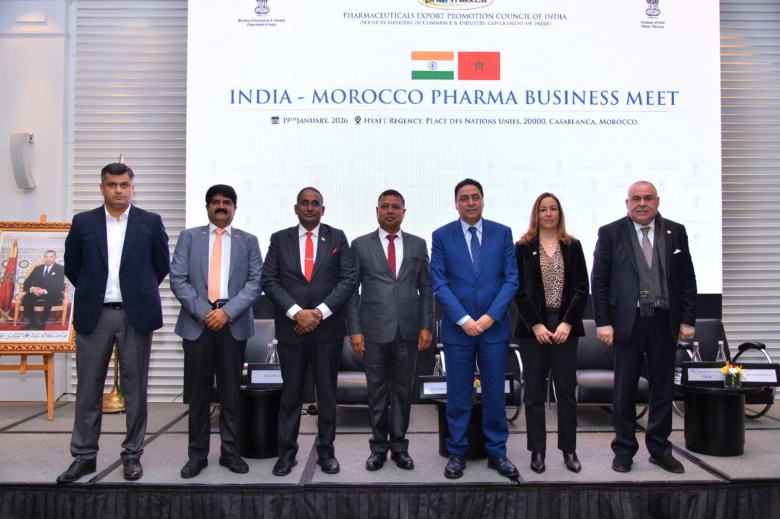
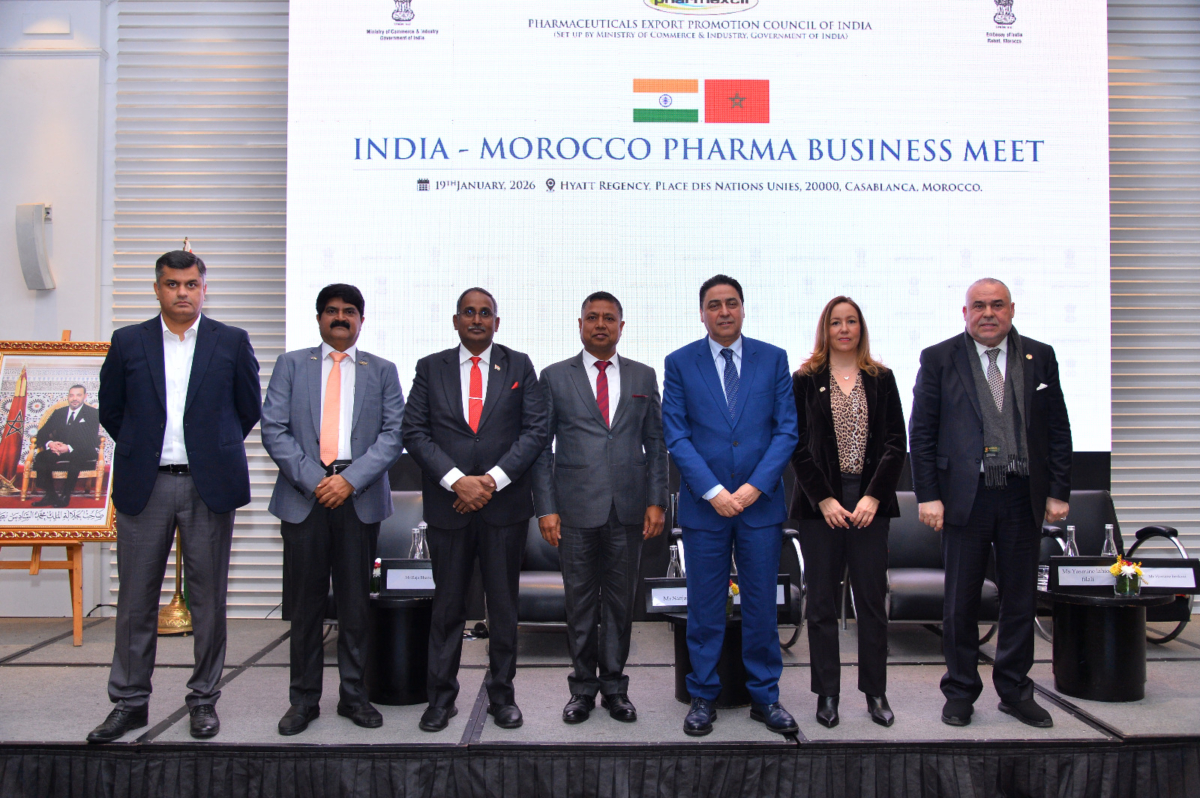
India and Morocco have stepped up efforts to deepen cooperation in the pharmaceutical sector, as the India–Morocco Pharma Business Forum was officially launched on January 19 in Casablanca, marking a new phase in industrial and healthcare collaboration between the two countries.
The two-day forum, held at the Hyatt Regency Casablanca, was inaugurated by Morocco’s Secretary of State for Foreign Trade, Omar Hejira, alongside India’s Ambassador to the Kingdom, Sanjay Rana. The opening ceremony brought together key institutional and industry figures, including Hassane Berkani, President of the Chamber of Commerce, Industry and Services of the Casablanca-Settat Region; Raja Bhanu, Director General of the Pharmaceutical Export Promotion Council of India (PHARMEXCIL); Yasmine Lahlou Filali, President of the Moroccan Federation of Pharmaceutical Industry and Innovation (FMIIP); as well as senior representatives from Morocco’s pharmaceutical sector.
Designed as a platform for concrete business engagement, the forum facilitated intensive business-to-business (B2B) meetings between 60 leading Indian pharmaceutical companies and their Moroccan counterparts. The Indian delegation reflected the full breadth of the sector, covering active pharmaceutical ingredients (APIs), intermediates, finished formulations, biological products and vaccines.
Speaking at the event, PHARMEXCIL Director General Raja Bhanu highlighted India’s position as the “Pharmacy of the World,” noting that the country’s pharmaceutical exports reached a record $30 billion last year. He stressed India’s capacity to supply affordable, high-quality medicines and inputs to global markets.
Ambassador Sanjay Rana underlined the positive momentum in bilateral relations, saying ties between India and Morocco are “developing from strength to strength” under the leadership of Prime Minister Narendra Modi and King Mohammed VI. He added that Indian pharmaceutical companies are well placed to offer sustainable and world-class solutions, ranging from essential APIs to advanced vaccines, in line with the evolving needs of Morocco’s healthcare system.
For his part, Secretary of State Omar Hejira pointed to Morocco’s growing potential in the production of generic medicines and biosimilars. Recalling his visit to India in September 2025 at the head of a high-level delegation, Hejira invited Indian firms to invest in Morocco and establish industrial partnerships, citing the country’s reliable infrastructure and its strategic access to international markets through an extensive network of free trade agreements.
Moroccan industry representatives also welcomed the initiative. FMIIP President Yasmine Lahlou Filali said Morocco has built a sophisticated pharmaceutical industry over more than five decades, operating to high quality and regulatory standards. This message was echoed by Hassane Berkani, who encouraged Indian companies to consider investing in the Casablanca-Settat region, pledging full support from the regional Chamber of Commerce.
Currently, pharmaceutical products account for around 10% of India’s total exports to Morocco, mainly in the form of essential raw materials used by local manufacturing facilities. Organizers said the India–Morocco Pharma Business Forum represents a milestone in strengthening economic ties between the two countries, with the potential to boost healthcare access, industrial innovation and investment across Morocco and the wider region.