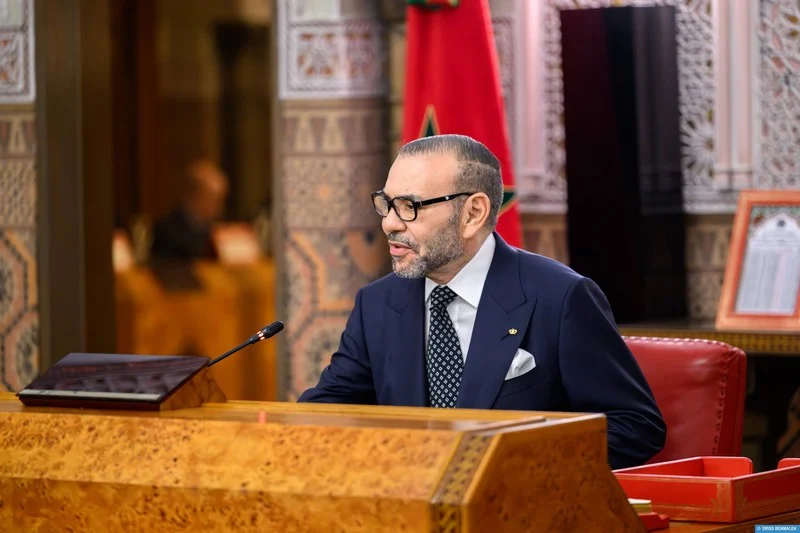
Morocco's King Mohammed VI presided over a Council of Ministers on Sunday at the Royal Palace in Rabat, during which the government approved a 140 billion MAD budget allocation for the health and education sectors and announced the creation of over 27,000 new financial positions to reinforce staffing in these key areas.
The Minister of Economy and Finance presented the 2026 Finance Bill, prepared in line with royal directives amid global economic uncertainty. Morocco’s economy is projected to grow by 4.8% in 2025, supported by domestic demand and a dynamic production sector, with inflation controlled at 1.1% and the budget deficit reduced to 3.5% of GDP.
The Finance Bill focuses on four main priorities:
- Consolidating economic gains by promoting domestic and foreign investment, implementing the Investment Charter, advancing green hydrogen initiatives, and supporting small and medium enterprises, with particular attention to youth and women’s employment.
- Launching integrated regional development programs to strengthen advanced regionalisation, reduce spatial disparities, and prioritise vulnerable areas including mountains, oases, coastal zones, and emerging rural centres.
- Advancing social policies, including the rollout of universal social protection, direct support to four million households, higher child allowances, and special assistance for orphans and vulnerable children.
- Continuing structural reforms and maintaining fiscal balance, including reforming the Organic Finance Law, improving governance of public institutions and companies, and modernising the judiciary.
The Council also approved four organic laws related to the House of Representatives, political parties, constitutional challenges, and the Constitutional Court, aimed at strengthening political governance and institutional stability. Two royal decrees concerning the Directorate of Information Systems Security and the Royal School for Military Health were also ratified.
In foreign affairs, Morocco signed 14 bilateral and multilateral agreements, covering judicial and military cooperation, social security, aviation services, and the avoidance of double taxation, reflecting the country’s engagement in international partnerships.
Additionally, the king appointed several governors and regional prefects, including Khalid Ait Taleb for Fès–Meknès, Khatib El Hebil for Marrakech–Safi, and Mohammed Atfawi for the Oriental region. Tarik Sennhaji was appointed Chairman of the Moroccan Capital Market Authority, reinforcing transparency and governance in the financial sector.
The 2026 Finance Bill reinforces Morocco’s “Rising Morocco” vision, aiming to balance economic growth, social justice, and integrated regional development, while consolidating a national development model based on efficiency and equity.