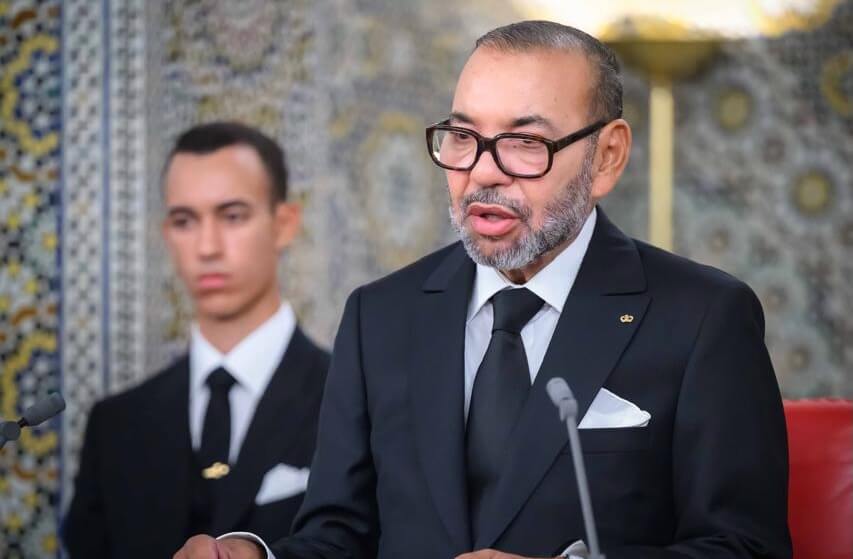
Morocco’s King Mohammed VI says the country is prepared to take part in international efforts aimed at reviving the Middle East peace process, following the ceasefire agreement that halted two years of fighting in Gaza.
In a message to Coly Seck, the chair of the UN committee on Palestinian rights, the King said the Kingdom’s position reflects its “firm belief in the just nature and centrality of the Palestinian cause” and its commitment to a “just peace”.
The message was issued to mark the International Day of Solidarity with the Palestinian People, commemorated on 25 November.
The King said that any renewed diplomatic initiative must be grounded in “clear principles” and set within a “reasonable timeframe”, warning against a continued reliance on short-term crisis management.
He said the ultimate objective remains “security, stability and prosperity for all peoples in the region”.
Referring to the ceasefire deal in Gaza, the King said he hoped “all its provisions and phases will be complied with”, arguing that this would end the killings, ease humanitarian suffering, and allow aid to enter the enclave “smoothly and sufficiently”.
He added that the agreement should pave the way for reconstruction efforts and create conditions for a “just and comprehensive political solution” to the conflict.
The King welcomed the agreement as a positive development and praised what he described as the “tireless efforts” and “personal involvement” of US President Donald Trump in securing it, as well as the contributions of other mediators.
Morocco, he said, is ready to contribute to the implementation of the ceasefire’s various phases.
King Mohammed VI outlined several principles he said must underpin any international push for peace.
He stressed the need to maintain the political and administrative unity of the Gaza Strip and West Bank under the Palestinian National Authority (PNA), which he said should ultimately govern a future Palestinian state with East Jerusalem as its capital.
He called for strengthening the PNA under President Mahmoud Abbas, boosting the Palestinian economy by easing restrictions, and encouraging intra-Palestinian reconciliation under the umbrella of the Palestine Liberation Organization.
He also urged the launch of “a serious negotiation process”, conducted within a clear timetable and based on the two-state formula, leading to a viable Palestinian state on the 1967 borders, living “in peace and security” alongside Israel.
The King said a lasting solution is impossible without addressing the status of Jerusalem “in a serious, responsible way”. As chair of the OIC’s Al-Quds Committee, he said he would continue efforts to preserve the city’s cultural identity and protect Islamic and Christian holy sites.
He expressed “deep concern” over what he described as growing unilateral Israeli actions in the city, warning they could trigger a “spiral of religious conflict” with consequences for the entire region.
The King also condemned the situation in the West Bank, describing it as “tragic and dangerous”, citing settlement expansion and daily attacks on Palestinians and their property, which he said threaten the viability of the two-state solution.
He noted growing international recognition of the State of Palestine and increasing global support for the two-state solution, pointing to the momentum generated by the Global Alliance for the Implementation of the Two-State Solution, an initiative led by Saudi Arabia and France.
Morocco co-hosted the Alliance’s fifth meeting with the Netherlands in May 2025.
The King said the two-state solution is now “an urgent necessity”, driven not only by “political realism” but by humanitarian and ethical considerations.