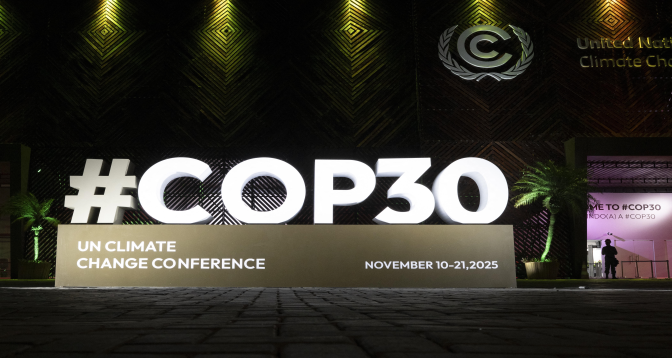
At a COP30 side event titled “Full Speed for Climate: Mobilizing Sports for Climate Action,” the Mohammed VI Foundation for the Protection of the Environment and the General Confederation of Moroccan Enterprises (CGEM) explored how sports can become a powerful catalyst for advancing global climate goals.
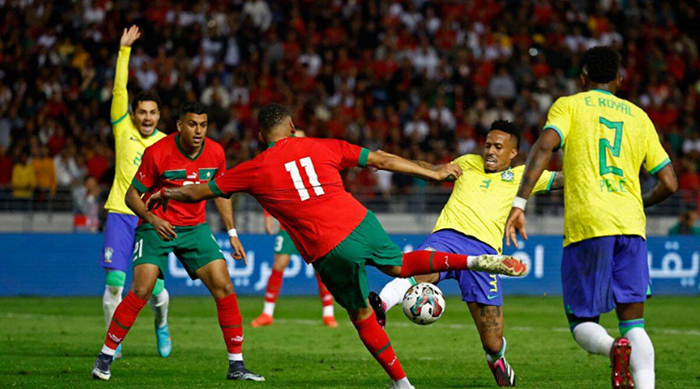
Held as Morocco prepares to host the 2025 Africa Cup of Nations and co-host the 2030 FIFA World Cup alongside Spain and Portugal, the session highlighted the potential of sports to accelerate climate action across Africa, the Mediterranean and Latin America. Speakers presented concrete initiatives ranging from waste-reducing local tournaments to regional leagues promoting clean energy and youth-led climate programs.
Representing the Mohammed VI Foundation for the Protection of the Environment, Ayman Cherkaoui, director of the Hassan II International Environmental Training Center, reaffirmed the Foundation’s commitment to supporting Morocco’s major transformational projects under the guidance of HM King Mohammed VI and the presidency of HRH Princess Lalla Hasnaa.
He emphasized the Foundation’s collaboration with the Royal Moroccan Football Federation (FRMF) on the environmental section of the joint Morocco-Spain-Portugal Bid Book submitted to FIFA. Cherkaoui underlined the multiple interfaces between sports and the environment, citing infrastructure impacts, the need to protect ecosystems to ensure long-term sports practice, and the sport sector’s unique power to raise environmental awareness among diverse audiences.
Youssef Chaqor, vice president of the CGEM Africa Commission, said Morocco’s private sector views sports as a strategic space to accelerate climate transition. With 90,000 companies represented within CGEM, he noted that sports are both exposed to climate risks and capable of influencing public behavior at scale.
Chaqor highlighted the growing involvement of Moroccan companies in developing low-impact infrastructure, sustainable mobility, renewable energy use, circular waste management and digital solutions for smart, efficient stadiums. He also pointed to available financing tools such as green Public-Private Partnerships and Article 6 mechanisms, stressing the role of sports in climate education, particularly among youth.
Speaking for the Ministry of Energy Transition and Sustainable Development, Rachid Tahiri warned that sports are becoming highly vulnerable to climate disruption—from extreme heat to rising seas threatening coastal facilities, along with scheduling disturbances.
He noted that sports also contribute to emissions through travel, energy consumption and logistics. Morocco, however, now places sustainability at the heart of its sports development strategy, supported by modern infrastructure, a diversified renewable energy mix and the country’s recognized environmental expertise.
Tahiri said AFCON 2025 and the 2030 World Cup represent opportunities to showcase an African model of sustainable sports, with clean-energy stadiums, green mobility between host cities, circular waste management and robust youth engagement. This vision is aligned with Morocco’s NDC 3.0 trajectory and its 2050 low-carbon strategy.
Lindita Xhaferi-Salihu of the UNFCCC presented updates on the “Sports for Climate Action” program, stressing that signatory organizations must measure, reduce and report their emissions to help keep global warming to 1.5°C. She highlighted the program’s five guiding principles—environmental responsibility, carbon-footprint reduction, climate education, sustainable consumption and responsible communication—and reaffirmed the pathway to halve emissions by 2030 and reach climate neutrality by 2040.
Niklas Hagelberg, global climate coordinator at UNEP, said sports federations and clubs have significant influence over consumption, energy and mobility patterns. He referenced the “Sports for Nature” initiative, which seeks to reduce ecological footprints, safeguard biodiversity and embed sustainability principles into event management.
Cathy Yitong Li of the International Union for Conservation of Nature (IUCN) also presented the “Sports for Nature” framework, linking it to broader climate action dynamics under the Marrakech Partnership for Global Climate Action.
Marcos Montoiro of the UN Convention to Combat Desertification highlighted the importance of sustainable land management and the role sports can play in preventing desertification, particularly in arid African regions.
Italian expert Edoardo Croci noted that sustainability will be central to the Milano-Cortina 2026 Winter Olympics, with Bocconi University collaborating with the Italian Olympic Committee on climate impact assessments.
Andrew Bowen, CEO of One Carbon World, detailed low-carbon financing tools for sports entities, including certified offsets and Article 6 cooperation mechanisms.
Brazil’s Earth Futball Club representative Laura Moraes showcased how football can be integrated into environmental education through climate workshops, clean-up activities and waste-reduction programs in schools and clubs.
From Argentina, Eco House Global director Carolina Monaco emphasized community-led solutions and youth-centered climate action, highlighting the surge in public engagement following Argentina’s 2022 World Cup victory.
Nigerian activist Oladosu Adenike, ambassador of the African Youth Climate Hub—a platform launched by HRH Princess Lalla Hasnaa in 2019—underscored the role of African youth in transforming sports and climate systems through awareness campaigns and leadership programs.
The event concluded with an intervention from Brazilian surfer and young climate activist Catarina Lorenzo. She paid tribute to HRH Princess Lalla Hasnaa for elevating the link between sports and the environment, and spoke about witnessing firsthand the impacts of ocean pollution and coral bleaching throughout her life as a surfer. She called for meaningful inclusion of children and youth in decision-making processes, adding that despite the challenges, surfing reminds her that “there is still much life left to protect.”