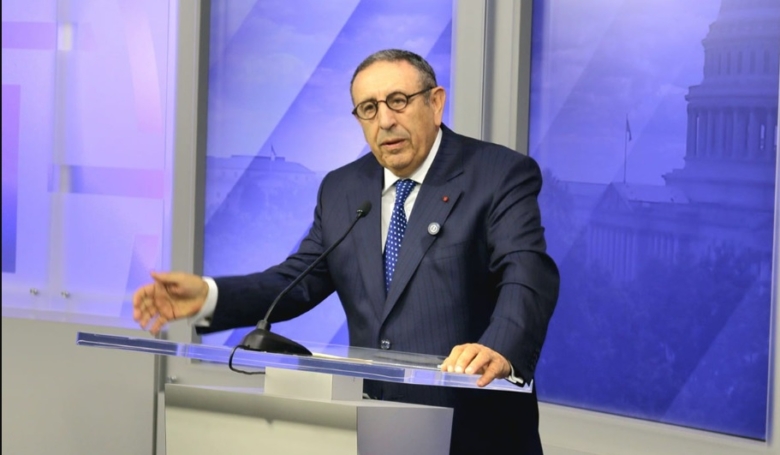
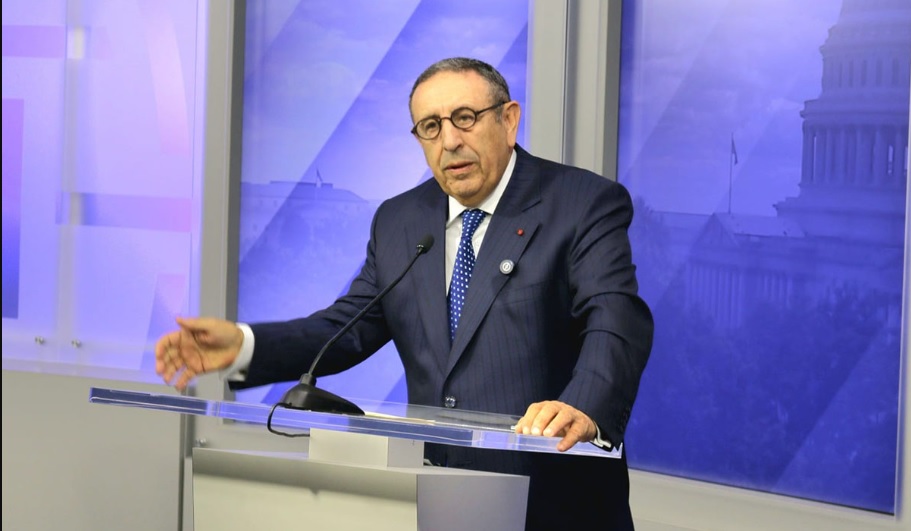
Morocco’s ambassador to the United States, Youssef Amrani, has said that King Mohammed VI’s Atlantic Initiative is transforming Africa’s western seaboard into a coherent geopolitical space with long-term strategic value.
Speaking on Thursday in Rabat during a panel titled “Morocco’s Commitment to the Atlantic”, part of the Atlantic Dialogues conference organised by the Policy Center for the New South, Amrani described the Royal Initiative as “a strategic framework that structures order, stability, connectivity and opportunity.” He was joined by Paulo Portas, former Portuguese foreign minister and member of the Academy of the Kingdom of Morocco.
Amrani said the ambition is to turn Africa’s Atlantic coast into a zone of opportunity, security and shared prosperity. Any credible regional architecture, he argued, must be underpinned by stability. “There is no Atlantic order without territorial integrity, and no long-term investment without predictable governance,” he said, pointing to the importance of UN Security Council Resolution 2797 on the Moroccan Sahara.
The resolution, he added, marks “a strategic shift not only for Morocco but for the entire Atlantic region,” by affirming Morocco’s Autonomy Initiative as the only basis for a political settlement and giving clarity to advance major projects across the Atlantic space.
Among these flagship projects, Amrani cited the Dakhla–Sahel Atlantic Corridor, the Dakhla Atlantic Port, the Tanger Med port complex, the African Atlantic Gas Pipeline, and future energy routes intended to support Africa’s green transition.
He said the integration driven by the Royal Atlantic Initiative will help establish the Atlantic as “a coherent strategic region where policies converge and long-term planning becomes possible.” The vision, he stressed, is inclusive—built on equal partnerships, African ownership of decision-making and regional mechanisms that allow the continent to “speak in its own voice.”
Innovation, he noted, has become indispensable as Africa navigates pandemics, climate shocks and vulnerable global value chains. Amrani highlighted the need for progress in energy, food security and stability-related innovation to reinforce resilience across the region.
The ultimate goal, he said, is to position Africa as a full actor in the global balance of power by giving it a unified strategic identity and geopolitical space. The Atlantic, he argued, forms a single arc from Tangier to Cape Town, encompassing the Sahel and linking Africa with Europe and the Americas through cooperation on stability, logistics, energy and climate challenges.
With the momentum generated by King Mohammed VI’s Atlantic Initiative, Africa stands to emerge as a strategic energy partner, a rising maritime and security actor, a connectivity hub and a leader in climate resilience, Amrani concluded.