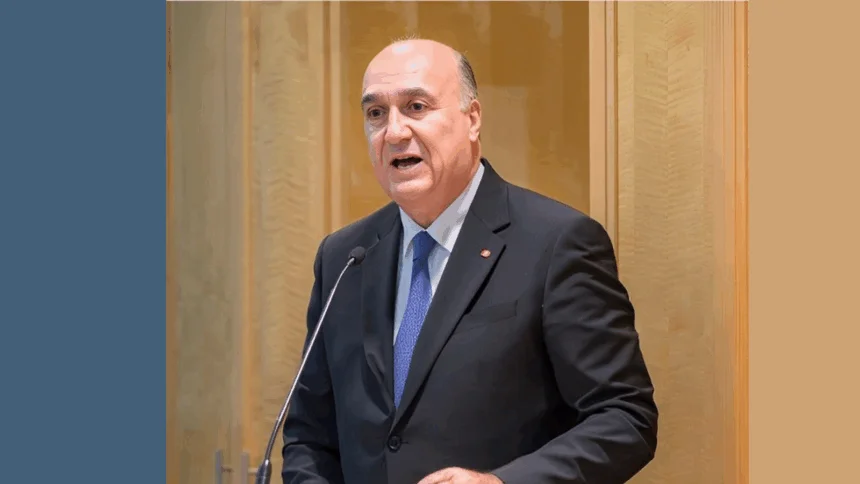
Former Tunisian diplomat Elyes Kasri said that the latest United Nations Security Council resolution on the Moroccan Sahara has put an end to what many considered a “myth” that fueled divisions and conflicts in North Africa for decades. By adopting Resolution 2797, the Council has effectively ended the existence of the so-called “Sahrawi Republic,” placing the Sahara on a new path based on autonomy under Moroccan sovereignty, he wrote on his official Facebook page.
Kasri, who previously served as Tunisia’s ambassador to India, Germany, Japan, and South Korea, said this decisive shift means that any future discussion of “self-determination” will now take place within the framework of a peaceful political solution that safeguards Morocco’s territorial integrity. The details of that process, he noted, will be shaped during the one-year extension of the UN Mission for the Referendum in Western Sahara (MINURSO), paving the way for a final settlement to a conflict that has lasted half a century.
According to Kasri, the positions expressed within the Security Council were as significant as the content of the resolution itself, particularly the abstentions of China and Russia—traditional allies of Algeria—and Algeria’s absence from the vote despite its non-permanent membership. This, he argued, reflects a profound shift in global power dynamics and in how the international community perceives Algeria’s role in the region.
The veteran diplomat warned that the new UN decision will trigger repercussions within Algeria’s ruling system, which, he said, has long built its legitimacy on two causes—Palestine and the Sahara—both of which have now led to its marginalization domestically and internationally. Kasri accused the Algerian regime of exploiting resources and territories taken from its neighbors to destabilize Africa, especially the Maghreb and Sahel regions.
He further claimed that the issue Algeria has promoted for decades as a “decolonization cause” is, in reality, nothing more than a fragile façade masking a politically troubled system seeking to hide its internal crises behind external slogans.
Kasri went as far as to assert that Algeria, “built on a falsified colonial legacy,” not only provoked regional instability but also seized land and resources from all its neighbors—including Tunisia, from which, he alleged, Algeria took more than 20,000 square kilometers rich in oil, water, and minerals.
He denounced what he called the “pathological fascination with the so-called big sister,” warning Tunisians who justify this situation under the guise of Maghreb brotherhood that Algeria’s economic and political dominance, disguised in nationalist rhetoric, is merely another form of dependency.
Addressing Tunisians who ask, “Where is the oil?”, Kasri said the answer lies not within Tunisia but westward, along its border with Algeria, where shared natural and underground water resources—particularly the vast Albian aquifer, the world’s largest—are being depleted. He warned that their mismanagement poses a threat to Tunisia’s economic sovereignty and water security.
Recalling a speech delivered by the late President Habib Bourguiba on February 5, 1959, Kasri reminded Tunisians that Bourguiba had openly referred to Tunisia’s historical rights in the Sahara. He lamented that the state later abandoned those claims due to illness, political maneuvering, and the 1980 Gafsa attack, which he said was orchestrated by “Libyan and Algerian brothers.”
Kasri argued that Tunisia has made costly concessions to neighbors who neither recognized nor respected its support during their struggles for independence. Those who believed such concessions would bring “friendship and prosperity,” he said, miscalculated badly.
He concluded by urging Tunisians to reclaim full national awareness and demand what rightfully belongs to them—both resources and land—stressing that “true independence is not measured by a flag and an anthem, but by effective sovereignty over territory and water.”