The parties concerned with the Sahara conflict are turning their attention to the upcoming UN Security Council meeting at the end of October, which will discuss developments in the file and vote on either extending or terminating the mandate of the MINURSO mission, amid numerous indicators suggesting the possibility of changes in this issue.
In this context, the American think tank Washington Institute published a report on Wednesday, addressing signals that point to a potential major shift in the mandate of the United Nations Mission for the Referendum in Western Sahara (MINURSO), possibly moving it from a ceasefire-monitoring mission to a political mission in support of Morocco’s autonomy plan.
The report noted that the annual vote to renew MINURSO’s mandate, scheduled for October 31, comes against the backdrop of UN pressure to cut peacekeeping budgets, rapid political shifts in the Sahara dispute, and the 50th anniversary of the Green March, which has brought the issue back to the forefront of international attention.
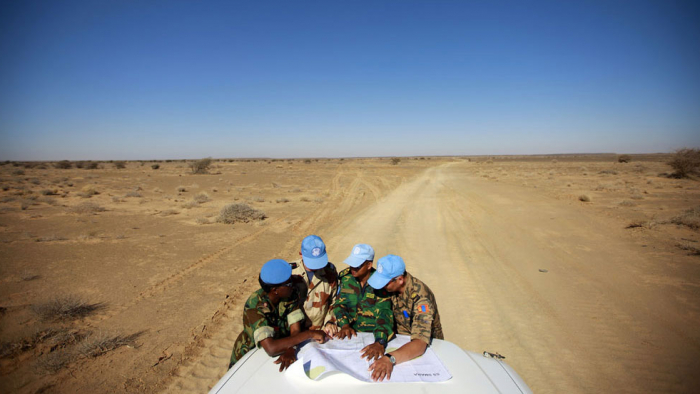
According to the report, MINURSO—established in 1991 with the aim of holding a referendum on either independence or integration—has effectively lost its original role due to disputes over voter eligibility. The referendum has not been mentioned in Security Council resolutions for nearly two decades. The report added that MINURSO’s tasks have gradually shifted to monitoring the ceasefire agreement, a role it described as “important,” particularly since tensions and clashes between Morocco and the Polisario Front resumed in 2020.
However, despite this “important” role, the Washington Institute report pointed out that continuing to renew the mission’s mandate annually without review has drawn criticism, with some parties—according to the report—seeing MINURSO’s presence as a symbol of diplomatic deadlock and an expansion of unjustified tasks.
The report also highlighted that the United States’ recognition of Moroccan sovereignty over the Sahara under the Trump administration in 2020 altered the dynamics of the conflict, and that the Western stance has been gradually leaning toward accepting Rabat’s autonomy proposal as a realistic solution.
In this regard, the report noted that French President Emmanuel Macron stated in 2024 that the future of the Sahara lies under Morocco’s sovereignty, while the United Kingdom described it as “the most credible basis” for resolving the dispute. It added that Rabat has benefited from this shift, particularly after U.S. Secretary of State Marco Rubio renewed Washington’s support for Morocco’s sovereignty in 2025 during Foreign Minister Nasser Bourita’s visit to the U.S. capital.
Returning to MINURSO, the report said the mission has been suffering from financial pressures due to U.S. decisions to withdraw hundreds of millions of dollars in funding for peacekeeping operations, which has reduced its operational capacity and staffing.
The Institute warned that the U.S. may call for a radical overhaul of the mission or even threaten to use its veto to block its renewal if expected adjustments are not met. It noted that Morocco, despite the shift in the mission’s role, has never called for its termination. Instead, Rabat has sought to cooperate with the mission and supports gradually turning it into a political mission that facilitates the implementation of autonomy.
The report also discussed Algeria’s position, noting that while it supports the principle of self-determination and backs the Polisario, it does not want a security vacuum or a collapse on the ground in the event MINURSO ends—pushing it to maintain a delicate balance in its stance.
The report added that Algeria heads into the upcoming meeting from a position of weakness, particularly given the growing support for Morocco’s stance and Algeria’s failure to secure backing from other Security Council members, such as Russia, which usually abstains. This situation, it argued, could push Algeria to soften its position on the Sahara issue.
The Institute concluded its report with several preliminary recommendations for managing the transition, including appointing a U.S. official to oversee the Sahara file, encouraging Rabat to develop a detailed autonomy plan, involving Algeria in the negotiations, and strengthening U.S.-French coordination to ensure the passage of any amendments.