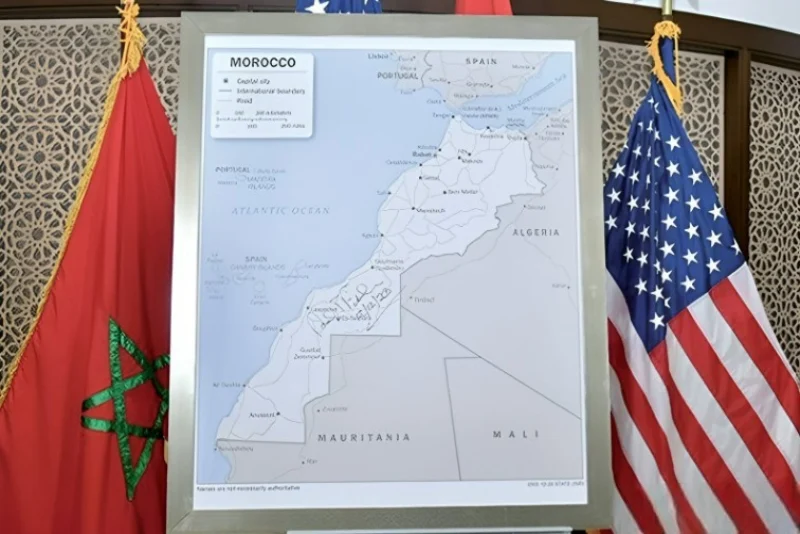
The United States is pressing ahead with efforts to resolve the Sahara dispute on the basis of Morocco’s autonomy plan, which Rabat has presented as the most viable framework to settle the long-standing conflict. Since Donald Trump’s return to the White House, U.S. Secretary of State Marco Rubio has repeatedly affirmed in recent months that Washington sees Morocco’s autonomy proposal as the foundation for a lasting solution.
According to Africa Intelligence, the U.S. administration has opened behind-the-scenes negotiations with Algeria aimed at pushing forward a political settlement based on autonomy under Moroccan sovereignty. The report noted that these discreet consultations are intended to break the deadlock and convince Algeria to seriously engage in the UN-led settlement process.
The visit of Masad Boulos, a senior advisor in the Trump administration, to Algeria earlier this year also centered on the Sahara issue, with Morocco’s autonomy plan reportedly topping the agenda in his discussions with Algerian officials.
In a later interview with an Algerian newspaper, Boulos made Washington’s position explicit, stating that “the only solution” the U.S. envisions for the regional dispute over the Sahara lies in Morocco’s autonomy initiative, which he described as a guarantee for regional stability.
This renewed American push comes as the UN Security Council prepares to hold its annual meeting in October to review developments on the Sahara file. According to Africa Intelligence, the Council is expected to extend the mandate of MINURSO for another year, a move the UN has routinely adopted amid the absence of a final settlement.
However, the new information regarding direct U.S. mediation with Algeria adds momentum to the upcoming Security Council session, which could translate into stronger language in the UN’s resolutions in support of the autonomy plan. U.S. diplomacy, observers suggest, may be setting the stage for a potential turning point in the dispute.
Analysts of the Sahara issue argue that Trump’s return to the White House has injected fresh momentum into U.S. foreign policy in the Maghreb, with Washington now working more decisively to bring the conflict to an end in a way that strengthens regional stability and limits the influence of rival powers.
Algeria, the main backer of the Polisario Front, has for decades opposed any solution based on autonomy, clinging instead to the option of “self-determination.” But growing international pressure is confronting Algiers with new challenges—particularly given Washington’s increasing insistence that autonomy is the only viable way forward.
All eyes are now on the upcoming Security Council meeting, where it will become clearer whether Washington’s latest moves will translate into stronger UN resolutions, bringing the conflict closer to resolution by consolidating Morocco’s autonomy plan as the cornerstone of a settlement.