In the far northeast of Morocco, where the mountains meet the sea, stands Ras El Ma (it can be translated into English as “Head of Water”), or Qabouyawa as the locals call it, perched on the shores of the Mediterranean, at a crossroads between isolation and beauty, between geography and memory. Here, everything seems to speak in the language of the sea, in the calm of the waves and the clarity of the sky.
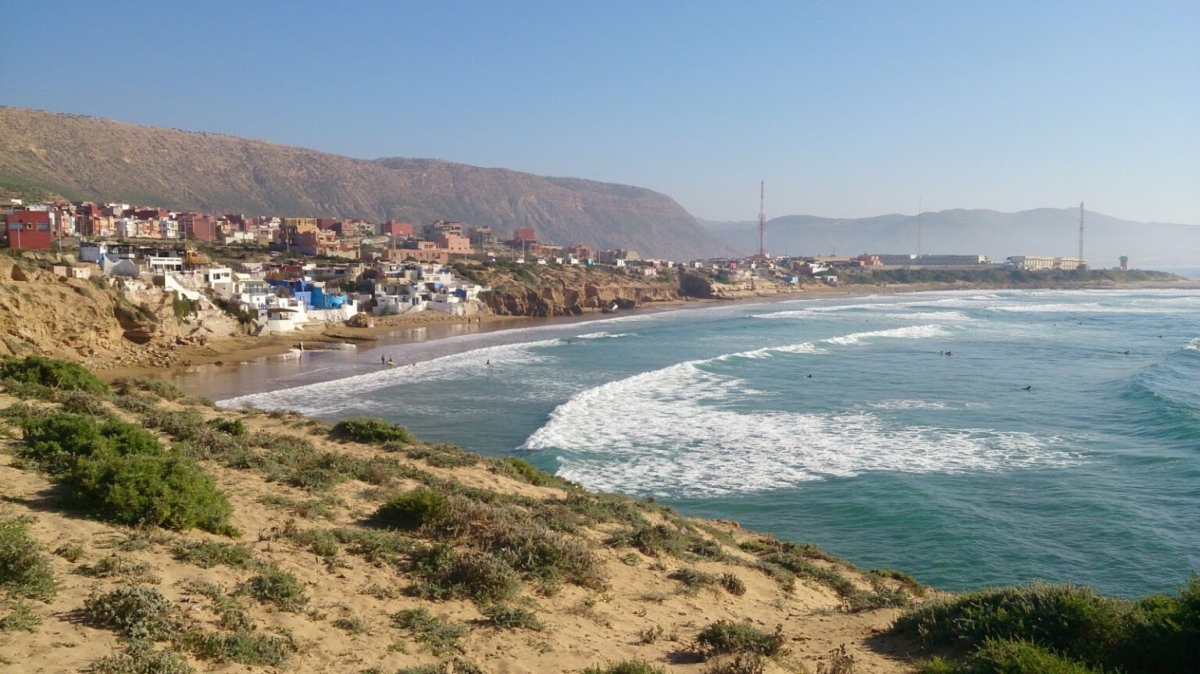
Ras El Ma, located in the eastern region of Morocco, within the province of Nador, has a population of 7,580 according to the 2024 census. It rests along the Mediterranean coastline like a blue ornament nestled between mountain ridges, welcoming the sea breeze for centuries.

Its strategic location makes it a natural link between the Saïdia tourist resort to the east and the mouth of the Moulouya River to the west, an area listed under the Ramsar Convention for wetlands of global ecological importance. In this tranquil corner of the Eastern Rif, the sea embraces the mountains, and nature meets memory in a scene that repeats itself daily without losing its magic.
Origin of the Name and History
The name itself tells the story of the place. Ras El Ma is not just a geographical label for a rocky headland overlooking the sea; it is a testimony to water as the essence of life around which human existence has formed for centuries. Its other name, Ras Kebdana, links it to the ancient Amazigh tribe that inhabited this coastal strip, inheriting from the Rif both the resilience of the land and the warmth of belonging.
Historically, Ras El Ma was tied to the Kebdana tribe, which served as a bridge between the Rif hinterland and the Mediterranean coast. It was part of old trade routes connecting Nador and Saïdia. The region also witnessed notable historical events, including the Spanish occupation of some nearby islands—the Chafarinas Islands—in 1848. Archaeological excavations conducted in 2012 revealed that these islands have been inhabited continuously for over 6,500 years.
The Kebdana tribe, to which Ras El Ma belongs, is a Rifian tribe of Zenata origin and is considered the eastern gateway to the Rif tribes. It is bordered by the Moulouya River to the east—beyond which lie the Ait Iznassen tribes—by the Mediterranean to the north, by the Oulad Settout tribe to the south, and by the Guelaya tribe to the west.

Historical references to Kebdana appear in many old sources, such as Hassan ibn Mohammed al-Wazzan (Leo Africanus), who described Mount Kebdana as extending from Ghassasa near Melilla to the Moulouya River in the east, and from the Mediterranean to the Kert river in the south. It was also mentioned by Abdelaziz Benabdallah, Charles-André Julien, and Moulieras, who described it as a strategic area linking the sea to the Rif interior, a factor that made it, throughout history, a space for trade and cultural exchange.
The Road to Ras El M: A Path Between Forest and Waves
Reaching Ras El Ma is a purely visual experience. From the city of Nador, a short 61 km drive eastward along coastal road N16—just over an hour by car or taxi—takes you through changing landscapes of forests, highlands, and endless waters.
The winding coastal road offers panoramic views that tempt you to stop repeatedly, passing through villages such as Kariat Arekmane, itself a place of quiet beauty. For visitors coming from Saïdia to the west, the distance is only 21 km—around 25 minutes by car along one of Morocco’s most scenic coastal routes.
Public transport is available throughout the day, especially in summer, via Grand taxis and regional buses departing from Nador, Zaio, and Berkane. The nearest airport, Al Aroui International Airport, is just 75 km away via national road N15, which connects to N16, making the town easily accessible even for visitors coming from faraway cities or abroad.
A Land that Brings Mountain and Sea Together
A single upward glance is enough to understand that this land was made to reconcile opposites: mountain and sea. Where the Mediterranean’s blue recedes from the shoreline, the lands of the Kebdana tribe emerge as green hills and rocky outcrops descending slowly toward the coast, as if the mountains stretch out their hand to the water in an ancient pact that cannot be broken.

The mountainous character dominates, but it is neither harsh nor barren—rather, gently contoured, like a face carved patiently by time. Near national road N16, between Arekmane and Ras El Ma, rises a majestic summit known to locals as Thamzoukhth, sometimes called The Seven Men.
This summit is more than just a geographical elevation of 923 meters above sea level, it is a natural observatory overlooking a breathtaking mosaic of scenery. From there, you can see the Mediterranean shimmering like a boundless mirror, with Arekmane village, Nador city, and the blue pearl of Marchica Lagoon drifting across the horizon.
Reaching the top of Thamzoukhth is an adventure worth taking, especially for hiking and mountain-climbing enthusiasts. The path winds through narrow passages wrapped with pine and juniper branches, while the distant sound of the waves rises like a guide unwilling to let you lose your way. Each step upward offers a new panorama.
And once you reach the summit, breathless and triumphant, the world opens its arms: the sea before you, the plains behind, and the scent of forests all around. In that moment, you realize Ras El Ma is not merely a beach—it is a land where mountain and sea share the same embrace.
From “Qabouyawa” to the Cliff of Adventurers
Upon arriving in Ras El Ma, the road will gently guide you toward the sea. No map is needed—every small alley leads instinctively to a distant sparkle of blue, and every house seems to whisper to the waves from its balcony. Here, the sea is not the end of the road—it is its beginning, the heart beating to the rhythm of the wind.
Ras El Ma’s beach, or Qabouyawa, stretches across fine golden sand caressed by the morning sea breeze, cleansing it like a memory washed free of the dust of days. At dawn, the scene begins: fishermen preparing for the sea, pulling their small boats toward the harbor; ropes and oars rasping; returning boats gliding in with the day’s catch; women walking among the piers and the local market with baskets filled with the scent of fresh fish—as though they are carrying pieces of the sea’s memory.

Walking along the coastline, you reach the most famous spot in Ras El Ma: the Lirochi Cliff, a natural balcony suspended between sea and sky. Youth line up there in summer, waiting for their turn to leap from great heights. Their bodies cut through the air like arrows of light before disappearing into the water in an instant. The place becomes an open-air theater of life—laughter, cheers, splashes, and the mingled voices of adventurers and spectators scattered across the rocks and cliffs.
If you enjoy walking and contemplation, follow the small path stretching north of the beach. The scattered rock formations resemble the ruins of an ancient marine fortress. Turn slightly east toward the small port, where seagulls circle the boats and waves draw their eternal rings around the rocks—here, Ras El Ma reveals its most poetic self, a place where sea meets humanity.
At sunset, prepare for an unforgettable spectacle: the horizon ignites with shades of gold and flame; seagulls glide slowly over the port; the sound of the waves blends with the laughter of passersby and the distant call to prayer from mosque minarets. The beach becomes a memory stretched across the horizon—everything pulls you back to something older, purer, and more beautiful, as if you were living a moment outside time.
And if you are a fishing enthusiast, don’t leave before trying your luck near the rocks around Lirochi, where fishermen gather in the evening. They stand silently at the edge of the sea, casting their lines and waiting—not caring much about what they might catch, but cherishing the moment when humanity becomes one with the ocean.
The Lighthouse and the Port: Ras El Ma’s Maritime Landmarks
All roads in Ras El Ma seem to lead there, to the point where the sea leans against the rocky cliff, where the town’s lighthouse rises like a watchful eye over the horizon. Sixty kilometers northeast of Nador, the white lighthouse appears from afar as a guiding sign for travelers crossing the sea, or as a silent prayer rising above the waves since 1945, when it was built by the Spanish to serve as a beacon for ships passing between Ras El Ma and the Chafarinas Islands.
From there, a narrow path leads you toward the port, where the town breathes its daily life. In the early morning, boats approach the quay laden with the bounty of the Mediterranean. Soon the place fills with the clamor of auctions and sailors’ calls; the smell of salt mingles with diesel fumes, and the sound of ropes pulling boats echoes through the air, in a scene that takes the visitor back to the time of the first village, when the sea was the mirror of life and the source of livelihood and longing.

The port, despite its modest size, holds the pulse of the entire town. From here, fish set off toward the markets of Nador, Berkane, and Oujda, and from here the restaurants of major cities are supplied with fresh Ras El Ma seafood. Here, between the lighthouse that watches over passing ships and the port that embraces those returning, the maritime image of the town is complete.
A Taste That Captures the Sea
When you set foot on Ras El Ma’s beach, the first thing that inevitably draws your attention is the scent of the sea blended with the aromas of local cooking. Here, the journey of flavors begins just as the horizon does. Walk along the corniche and you will encounter a chain of small, medium, and even upscale restaurants, each one opening onto the sea. Visitors sit on terraces, breathing in the Mediterranean breeze and watching the waves dance on the sand, sometimes accompanied by melodies of authentic Rif music, making you feel as if the place itself is singing to you.
You can choose your fish yourself, straight from the boats returning from their early-morning fishing trips. You will find the cook grilling it before your eyes over charcoal, as the sound of the sea blends with the aroma of crispy fresh fish. On the table, a variety of dishes awaits you: tender sardines, flavorful hake, grilled prawns, and calamari cooked over charcoal or simmered in a tagine with olive oil and lemon. Each dish carries the taste of the sea and the spirit of Ras El Ma, served alongside fresh tomato and onion salad and warm bread just out of a nearby oven, turning every bite into a short journey between the beach sands and the depths of the sea.
Do not forget to pause for a moment with a glass of Moroccan mint tea, seated on one of the terraces overlooking the sea, where the steam of the tea intertwines with the moist breeze and the melody of the waves whispers in your ear—a small moment, yet enough to feel the authenticity of life in Ras El Ma.
When the Sea Closes Its Doors Behind You the Echo Remains
Despite its calm, rural character, Ras El Ma has witnessed gradual urban expansion thanks to growing tourist interest. Guesthouses and rental homes are spread throughout the area, with prices suitable for different budgets, ranging between 300 and 800 dirhams per night depending on the season and location, alongside a number of small hotels offering decent services and ideal seaside locations. Some visitors also choose camping in nearby natural areas, or staying with local families who welcome guests with genuine Rif hospitality.
And when you leave Ras El Ma, it feels as though you are departing from the familiar world—yet the place does not leave your mind. The sea horizon wrapping around the port like two embracing arms, the scent of salt mixed with the air of the Rif, the voices of fishermen at dawn, and the laughter of children dancing on the sand—all follow you with every step after departure.
The uniqueness of the Rif region adds an unforgettable layer of charm: dirt paths leading through cultivated fields, traditional houses intertwined with nature, and Rif herbs exuding the fragrance of authenticity. All of this makes the visitor feel as though they have taken a piece of the place’s soul with them. Ras El Ma is not merely a beach or a port—it is an experience etched into memory.