
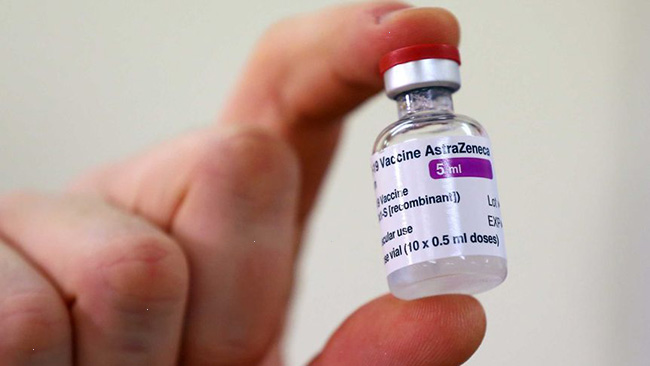
Denmark on Thursday announced a 14-day suspension of Covid-19 vaccinations from pharmaceutical company AstraZeneca after reports of severe cases of blood clots in people who have received it, prompting other countries to follow suit.
Danish Health Minister Magnus Heunicke stressed that the suspension was "precautionary."
The Danish Public Health Authority said earlier that it is investigating potential adverse effects related to the jab, noting blood clots in some vaccinated patients.
A death has been reported in Denmark - although it was not certain there was a link between the British-Swedish company's vaccine and the formation of blood clots, the Danish Health Authority said.
Iceland and Norway later announced similar suspensions.
In Norway about 121,000 people have been vaccinated with the AstraZeneca vaccine, Norwegian authorities said.
"We will await information if there is a connection between the vaccine and this case of blood clots," said Geir Bukholm, who is with the Norwegian Institute of Public Health.
Meanwhile, Sweden's Medical Products Agency said there was insufficient information to suspend inoculations with the AstraZeneca vaccine, but it would continue to monitor developments.
Veronica Arthurson of the Swedish agency told a briefing that it has had two cases of thrombosis linked to the AstraZeneca jab and about 10 cases of thrombosis linked to the vaccine produced by US-German venture Pfizer/BioNTech.
She noted that more than 1 million vaccinations have been conducted in Sweden.
Finnish authorities said they were also looking at possible side effects linked to the AstraZeneca jab, but had no current plans to suspend inoculations with the vaccine.
The European Medicines Agency (EMA) has launched an investigation into the vaccine, as have national health authorities in several European countries.
"There is currently no indication that vaccination has caused these conditions, which are not listed as side effects with this vaccine," the EMA statement said.
The Amsterdam-based EMA noted that "the number of thromboembolic events in vaccinated people is no higher than that seen in the general population."
As of Tuesday "22 cases of thromboembolic events had been reported among the 3 million people vaccinated with Covid-19 vaccine AstraZeneca in the European Economic Area," it added.
Later, the EMA said its safety committee's position "is that the vaccine’s benefits continue to outweigh its risks and the vaccine can continue to be administered while investigation of cases of thromboembolic events is ongoing."
The French Health Ministry said it would monitor the vaccine, but would continue to use it in the country's vaccine programme.
Europe, France and Germany currently believe there is no excessive risk, French Health Minister Oliver Veran said on Thursday evening.
AstraZeneca said it was "aware" of Denmark's decision following reports of side effects.
"Patient safety is the highest priority for AstraZeneca. Regulators have clear and stringent efficacy and safety standards for the approval of any new medicine, and that includes Covid-19 vaccine AstraZeneca," the British-Swedish company said in a statement.
"The safety of the vaccine has been extensively studied in Phase III clinical trials and peer-reviewed data confirms the vaccine is generally well tolerated," AstraZeneca added.
During a visit to Norway, British Foreign Secretary Dominic Raab said he was "confident" that the jab is safe.
He said that, while Britain had tested the jab, he understood and respected each country's safety processes, and Norway's approach, in comments at a press conference with his Norwegian counterpart, Ine Eriksen Soreide, in Oslo.
In Denmark, there were questions about what the delay would mean for the countries fight against the coronavirus.
"We are in the middle of the largest and most important vaccination rollout in Danish history, and we need all the vaccines we can get. Therefore, putting one of the vaccines on hold is not an easy decision," said Soren Brostrom, head of the Danish Health Authority.
The suspension could cause a four-week delay in Denmark's vaccination programme, one projection suggested.
Denmark and other Nordic countries also use two other vaccines, the Pfizer/BioNTech jab and one developed by US firm Moderna.
About 9 per cent of Denmark's adult population have so far received one dose. A quarter of those had the AstraZeneca jab.
Denmark, a country of 5.8 million people, has so far recorded almost 218,000 coronavirus cases and a death toll of 2,382.